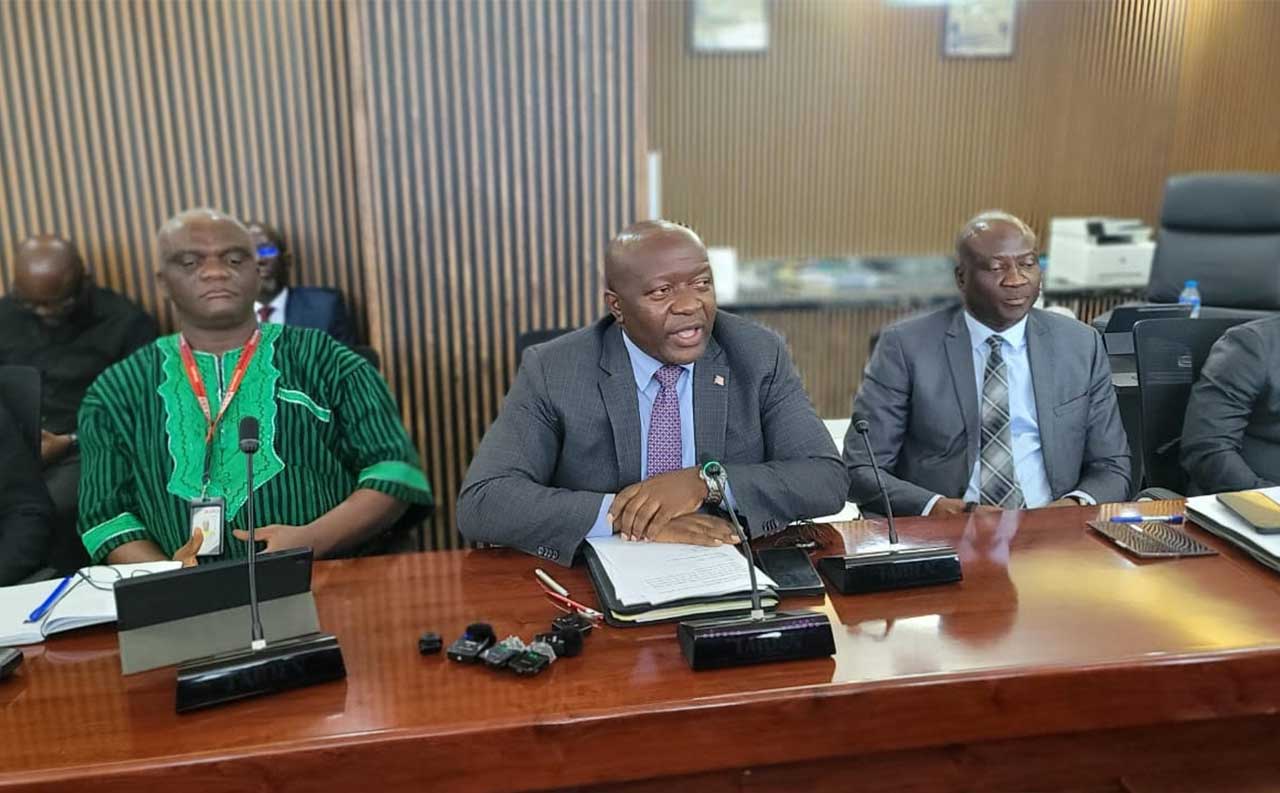
The Government of Liberia has launched a major investigation into possible revenue leakages and financial irregularities after a compliance audit uncovered serious discrepancies within the country’s revenue collection and reconciliation systems. At a joint press conference held Tuesday, May 19, 2026, in Monrovia, Minister Augustine Kpehe Ngafuan of the Ministry of Finance and Development Planning (MFDP), Henry F Saamoi, Governor of the Central Bank of Liberia (CBL), and James Dorbor Jallah, Commissioner General of the Liberia Revenue Authority (LRA), disclosed that the audit revealed troubling gaps between revenues recorded in government tax systems and actual deposits made into government accounts.
Addressing reporters, the Finance Minister said the investigation began after authorities detected inconsistencies in late 2024 involving revenues reported in the Tax Administration System (TAS) and deposits reflected in the Government’s General Revenue Account at the Central Bank of Liberia.
“As custodians of public trust, we could not and would not ignore these concerns,” the minister stated. According to him, the government formally requested an independent investigation by the General Auditing Commission (GAC) on January 6, 2025. The audit, which covered the period from July 1, 2018, through December 31, 2024, according to Ngafuan, was later expanded to include the 2024 fiscal year to ensure what officials described as a “complete and credible assessment.” He told journalists that the audit reportedly uncovered discrepancies between revenue recorded in transit bank accounts at commercial banks and funds deposited into the Central Bank.
Additional concerns, the Minister stated included variances between customs and tax administration systems, unauthorized withdrawals from transit accounts, and irregular reversal transactions involving government revenue. However, Liberia’s Finance Minister admitted that the findings exposed “systemic weaknesses, reconciliation gaps, and operational deficiencies” across Liberia’s revenue collection chain.
Also, he disclosed that President Joseph N. Boakai has already directed that the audit report be forwarded to the Ministry of Justice and the Liberia Anti-Corruption Commission (LACC) to determine whether criminal fraud occurred and to prosecute anyone found responsible.
“Anyone found capable of defrauding the government over the seven-year period of this audit will be brought to justice,” the minister warned. He added that said corrective measures are already being implemented to strengthen accountability and prevent future leakages. Among the actions announced by the Minister are revised agreements with commercial banks, daily reporting requirements for revenue transfers, expanded deployment of automated customs and tax systems, and quarterly reconciliation exercises among revenue-generating institutions.
He also revealed plans to integrate key government financial systems to allow real-time tracking and reconciliation of revenues across agencies and banks. In addition, the Finance Minister said it is in advanced discussions with private sector experts and technology firms to help modernize revenue monitoring and reconciliation systems.
“One of the firms expected to support the process is linked to former Auditor General John S. Morlu Il,” he added. However, Minister Ngafuan praised the General Auditing Commission for conducting what officials described as a difficult and sensitive audit, while pledging full cooperation as investigations and reform efforts continue.
He said the revelations are expected to increase public pressure on the government to ensure accountability and recover any public funds that may have been lost through fraud, negligence, or systemic failures.