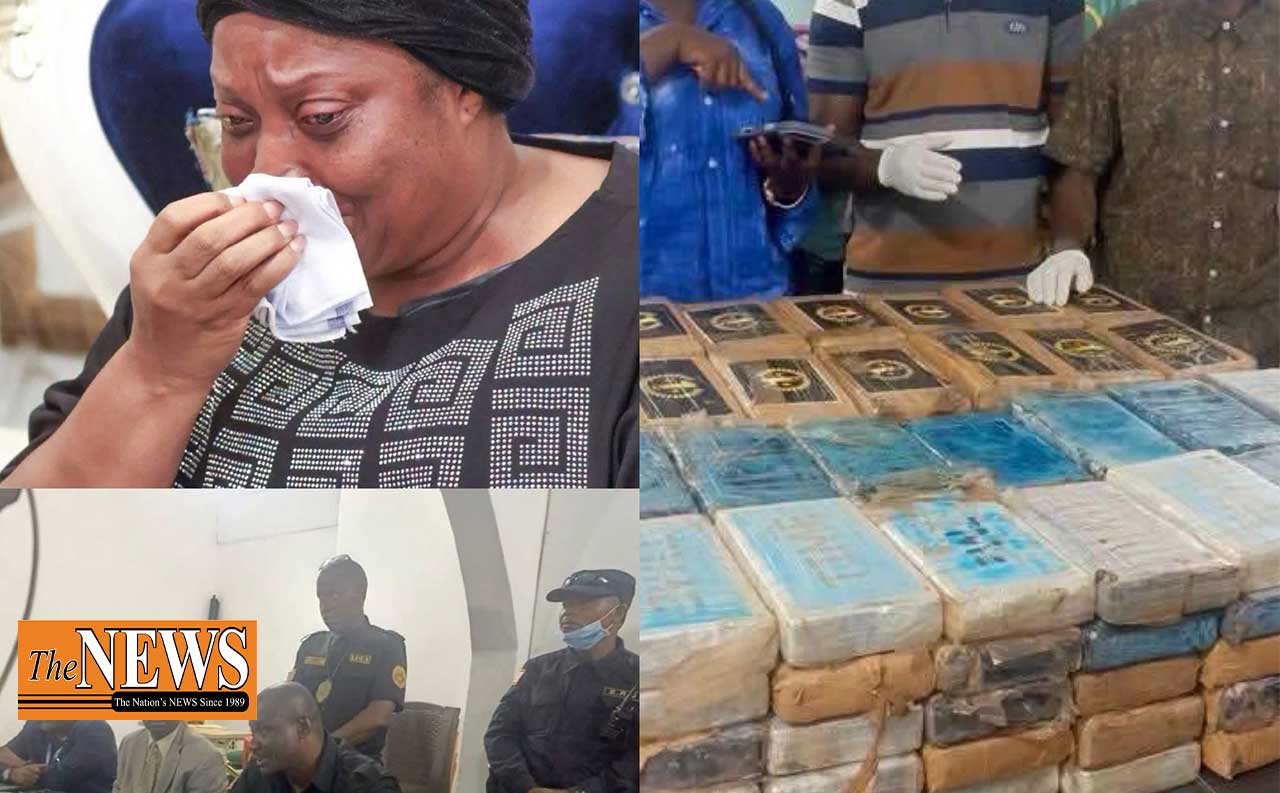
The formal charging of former Vice President Jewel Howard-Taylor in connection with the alleged trafficking of 237.6 kilograms of cocaine valued at US$19.2 million has transformed what was already a major narcotics investigation into one of the country’s most politically consequential criminal cases.
Justice Minister and Attorney General Cllr. N. Oswald Tweh says the charges followed months of investigation by the Joint National Security Investigative Task Force, working with international law-enforcement partners.
According to the government’s account, the former Vice President faces allegations including illicit importation, distribution and transportation of controlled substances, narcotics trafficking, criminal solicitation, facilitation and conspiracy, as well as money laundering. Tweh has characterized the investigation as potentially involving organized criminal networks with a “very great potential transnational dimension.”
But as prosecutors prepare to build their case, another episode from Howard-Taylor’s tenure as Vice President is likely to attract renewed attention-the 2022 diplomatic-passport controversy involving businessman Sheik Bassirou Kante.
The two matters are legally distinct. There is no established evidence, based on the information currently available, that the 2022 passport affair was connected to the 2026 cocaine seizure. Yet, prosecutors could seek to use the earlier episode, if legally admissible and factually supported, to provide context about alleged access to official privileges, relationships with persons under foreign investigation or the misuse of government instruments.
That possibility makes the passport controversy politically relevant, but its legal value is far less straightforward. The government’s case against Howard-Taylor is centered on the June 2026 seizure at Roberts International Airport.
The State says 237.6 kilograms of cocaine, valued at approximately US$19.2 million, were intercepted. Tweh says the investigation has extended beyond the drugs themselves to the alleged network responsible for bringing them into Liberia.
Two Croatian nationals and one Ukrainian national have reportedly been indicted in absentia as alleged organizers or members of the same trafficking network. The Justice Ministry has also identified several categories of persons of interest, including airport security officials, cargo handlers, scanner operators and personnel associated with airport ground handling. Former National Security Agency Deputy Director for Administration Joseph Gerald Smith has also reportedly been invited for questioning.
That broadening of the investigation is important. It suggests that the government’s theory is not simply that narcotics arrived at RIA, but that investigators are attempting to determine how the shipment entered Liberia, who facilitated it, who knew about it and whether there was a wider network operating inside the country.
That is consistent with Tweh’s insistence that the matter is being treated as a national-security and organized-crime investigation rather than merely a drug-possession case. “The investigation will follow the evidence wherever it leads, regardless of status or political affiliation,” Tweh said. “No one is above the law.”
The significance of that declaration will ultimately be measured by the evidence prosecutors present in court. Fresh claims emerging in connection with the ongoing drug investigation alleged that former Vice President Howard Taylor facilitated the issuance of a Liberian diplomatic passport to a man identified as Bashiru, who is reportedly among the individuals linked to the drug case.
According to the cradle sources, Bashiru was allegedly presented as a staff member attached to the former Vice President’s office, a position that reportedly enabled him to obtain diplomatic documentation.
Sources further claim that Bashiru and former VP Taylor had a close relationship, although the exact nature of that relationship and the circumstances surrounding the alleged passport issuance remain unclear. Four years before the cocaine seizure, Liberia was confronted with another controversy involving a government-issued document and a person facing serious criminal allegations abroad.
In April 2022, U.S. authorities arrested Sheik Bassirou Kante in connection with allegations involving wire fraud and money laundering. During a search of his Maryland residence, authorities reportedly found a Liberian diplomatic passport. The discovery raised questions because Kante was not known to hold a formal diplomatic position.
The controversy prompted then-President George Manneh Weah to order an investigation into how Kante obtained the passport and to direct the Ministry of Foreign Affairs to halt issuance of diplomatic passports without presidential authorization.
Though Howard-Taylor’s office denied that she recommended or arranged the issuance of Kante’s diplomatic passport. Contemporary reporting quoted her office as saying that she had interacted with Kante but had not recommended issuance of the passport.
The State may believe that the passport episode helps establish a pattern involving access, relationships or alleged abuse of official privilege. Contemporary reporting confirms that her office denied recommending the passport. Legal experts say if prosecutors want to connect the passport affair to the cocaine case, they would need evidence capable of establishing a specific and legally relevant connection.
“That could be substantially different from simply presenting the 2022 scandal to the jury and asking jurors to draw their own conclusions. This is perhaps the strongest theoretical argument available to prosecutors-but also one that requires careful construction,” they observed.
If confirmed, the allegations could raise serious questions about how diplomatic passports were issued, who qualified for them, and whether official positions were used to provide privileges or protection to individuals who may have been involved in criminal activities.
“These are serious allegations, and the relevant authorities should establish the facts, including whether Bashiru was officially employed by the former Vice President’s office, whether he legally qualified for a diplomatic passport, who authorized its issuance, and whether the former Vice President had any direct involvement,” a legal expert who preferred anonymity.