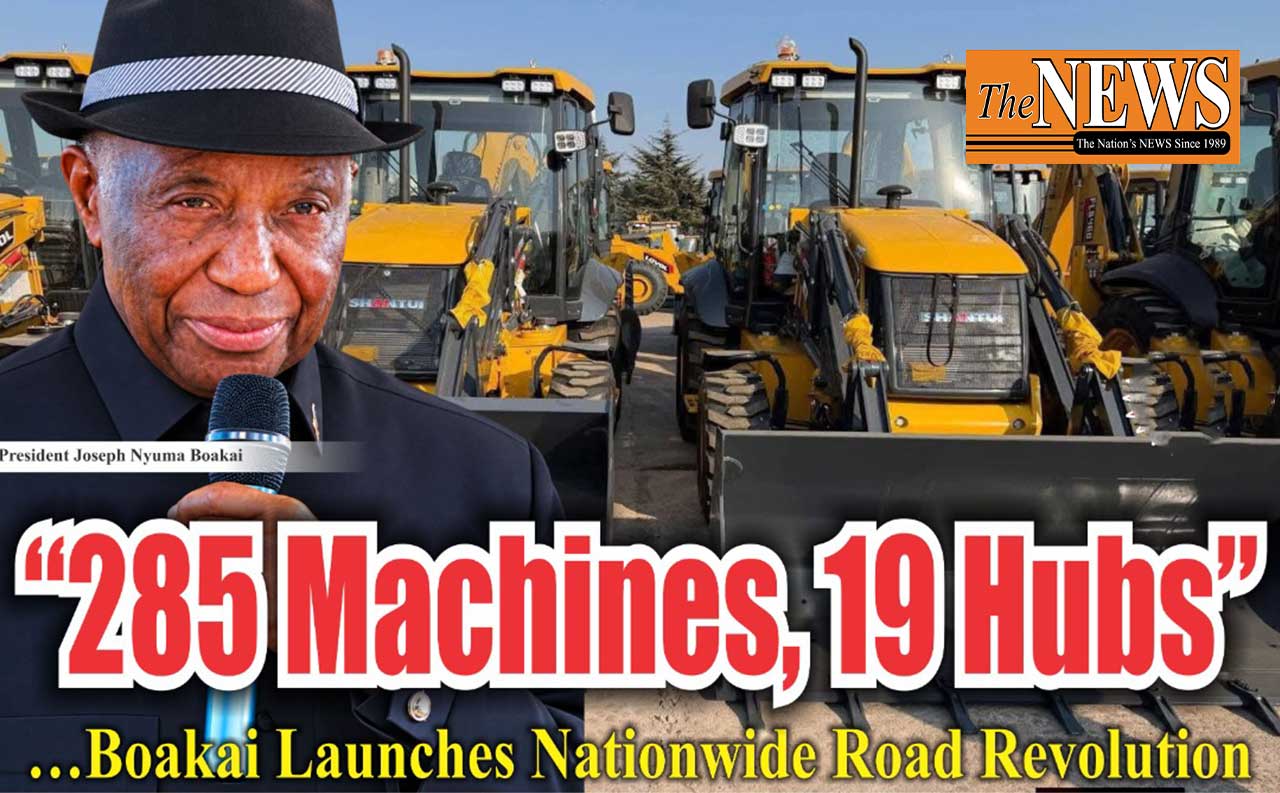
President Joseph N. Boakai has launched a nationwide deployment of 285 heavy-duty road construction equipment across Liberia’s 15 counties, which his administration describes as a major push to transform rural infrastructure, strengthen agricultural production, and connect isolated communities to economic opportunities.
The initiative, organized through 19 operational hubs, is expected to support the rehabilitation, improvement, and maintenance of feeder roads, farm-to-market roads, and other critical road networks across the country.
Speaking Monday, November 16, 2026, at the official launch of the Special Presidential Coordinating Committee (SPCC) Yellow Machine Project, President Boakai described the equipment as more than an investment in machinery, saying it represents a commitment to farmers, rural communities, and Liberia’s long-term development.
According to him, poor road conditions remain one of the greatest obstacles to rural development, preventing hardworking farmers from transporting their agricultural products to markets and limiting economic activities in several parts of the country.
The President explained that during the rainy season, many roads become difficult or impossible to travel, leaving communities isolated, increasing transportation costs, driving up food prices, and contributing to the loss of agricultural produce. Also, he pointed to the difficulties rural residents face in accessing schools, hospitals, and other essential services because of inadequate road infrastructure.
Speaking, President Boakai argued that improving agricultural production requires more than urging citizens to work harder, stressing that the government must create an enabling environment through infrastructure and other necessary support systems. “Sometimes we say that people are lazy, but sometimes we need to create an enabling environment, something that the people cannot do themselves,” he stated.
Moreover, the president said the 285 machines, strategically distributed through 19 operational hubs, are intended to address these longstanding challenges by improving rural connectivity and ensuring farmers have better access to markets.
However, while celebrating the deployment, President Boakai issued a strong warning against poor management and maintenance, insisting the initiative’s success will depend on the ability of responsible institutions to keep the equipment operational over the years.
“Maintenance, maintenance, maintenance,” he emphasized, describing preventive maintenance as a fundamental requirement of the national program.
Speaking, Boakai cautioned that heavy-duty equipment requires significant financial resources, technical expertise, and professional management, warning that without regular servicing, even the best machines would eventually become useless.
Using the familiar Liberian experience of poorly maintained vehicles, the President criticized the tendency of allowing minor mechanical problems to worsen before taking action.
Therefore, he called on the SPCC, the Ministry of Public Works, the Yellow Machine Board of Authority, and other relevant government institutions to establish proper maintenance schedules, technical support systems, operational procedures, and performance-monitoring mechanisms.
To encourage accountability, President Boakai disclosed that counties could be periodically assessed based on their management and maintenance of the equipment, with future consideration to reward good performance. “Periodically, counties will be graded, and counties that perform well will be rewarded,” he said.
He further challenged government institutions responsible for the initiative to uphold high standards of accountability, efficiency, operational discipline, and transparency in managing the national investment.
According to him, the true success of the Yellow Machine Project will not be determined by the launch ceremony but by the condition of Liberia’s roads and the performance of the machines five years from now. “The true measure of success will not be today’s ceremony that we are having. It will be the condition of our roads five years from now,” President Boakai declared.
He said the government would consider the investment successful if the machines remain functional, rural roads remain accessible, and communities experience meaningful improvements in infrastructure and economic opportunities.
Addressing operators, mechanics, managers, and technical personnel, the President urged them to handle the machines responsibly, maintain them professionally, and recognize their responsibility to the Liberian people. However, the Liberian leader called on citizens to protect the equipment, stressing that the machines belong to Liberia and are intended to serve communities across the country.
President Boakai acknowledged the contributions of Vice President Jeremiah Kpan Koung, former Minister of State for Presidential Affairs Sylvester Grigsby, the Minister of Public Works, the General Services Agency, and the entire SPCC team for their efforts in making the initiative possible.
He subsequently declared the Yellow Machine Project officially launched, calling on the equipment to begin operations across the counties. “Let the roads connect our communities. Let our farmers reach their markets. And let development and prosperity reach every county of our beloved Republic,” he said.