After weeks of testimony and legal arguments in one of Liberia’s most closely watched human trafficking prosecutions, a jury at Criminal Court “A” on Monday, July 6, 2026, unanimously found Bill Plato and all of his co-defendants guilty of Trafficking in Persons, Criminal Conspiracy, and Theft of Property.
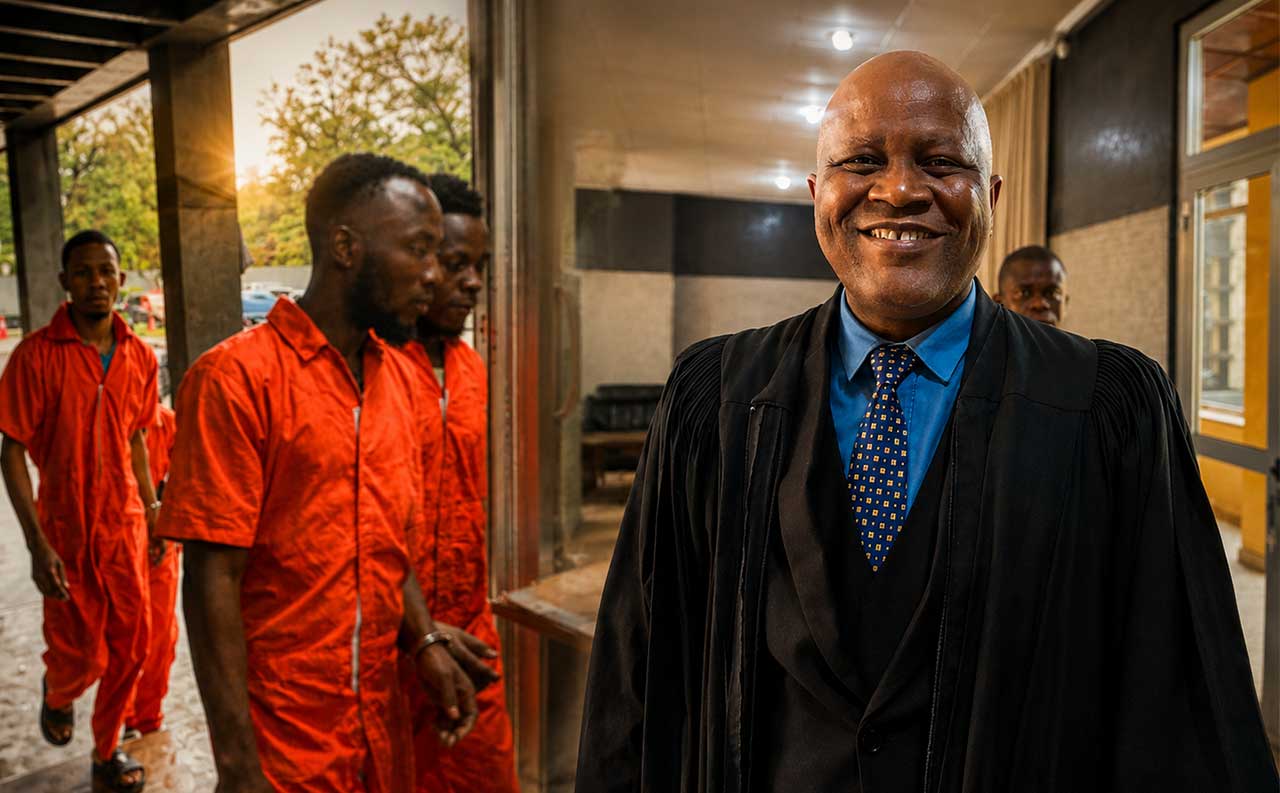
The unanimous verdict returned after approximately 30 minutes of deliberation was announced before Resident Judge Roosevelt Z. Willie, bringing to a close the trial that centered on allegations that dozens of Liberians were fraudulently recruited with promises of travel opportunities to Canada before being exploited and financially defrauded.
According to the indictment filed by the Grand Jury for Montserrado County, prosecutors alleged that between October 2024 and 2025, Bill Plato and more than 20 co-defendants recruited 57 victims-22 women and 35 men from seven counties across Liberia under the false promise of facilitating their travel to Canada for better employment and living opportunities.
The prosecution alleged that the victims collectively paid approximately US$124,921 to the defendants for travel arrangements that never materialized. State prosecutors further alleged that after arriving in Monrovia, many of the victims were taken to a fenced compound in Gbangba Town along the Roberts International Airport Highway, where they were unlawfully confined, deprived of their freedom of movement, and subjected to degrading treatment.
According to the prosecution, the victims were forced to endure prolonged exposure to the sun, carry heavy objects, drink excessive quantities of water, and repeatedly contact relatives to send additional money to the defendants.
The indictment also contained allegations of sexual violence involving several female complainants. Prosecutors alleged that multiple victims were sexually assaulted by some of the defendants while being held at the compound. Medical reports presented during the trial were cited by the prosecution in support of those allegations.
The government further alleged that the defendants confiscated victims’ mobile phones and travel documents, effectively preventing them from communicating with family members or leaving the premises until they were rescued by authorities.
Prosecutors argued that the accused operated through entities identified as Infinity Millennials and Platinum Star Limitless, which they alleged were used as fronts to recruit, harbor, and exploit victims under the guise of overseas travel and business opportunities.
They prayed the panel jury to find all of the defendants guilty based on the evidence produced. During final arguments, with each side allotted one hour and thirty minutes, lead defense counsel Cllr. Sennay Carlor II, representing all of the defendants, urged the jury to acquit his clients, arguing that the prosecution had failed to prove its case beyond a reasonable doubt. Carlor contended that the evidence presented by the State was insufficient and riddled with reasonable doubt.
He reminded the jurors that under Liberian law, where doubt exists in the prosecution’s case, the accused must be found not guilty. However, he added that if the jury concluded the evidence was sufficient to establish every element of the offenses charged, then it should return a guilty verdict.
Reviewing the prosecution’s evidence, Carlor referred to testimony from subpoena witness Wilma Senkpeni of the Liberia Revenue Authority (LRA), who testified that Infinity Millennials Platinum Star Limitless was legally registered in Liberia on September 27, 2022. He also cited testimony from another subpoena witness, James Farmah, who likewise confirmed that the organization was registered under the laws of Liberia.
According to the defense, the complainants voluntarily conducted business with the organization, paid money for products, and received official receipts bearing the company’s name and letterhead.
Carlor II argued that because the organization is a legally registered corporate entity capable of suing and being sued, any dispute arising from those transactions should have been pursued as a civil matter rather than through criminal prosecution. He further argued that the prosecution had violated his clients’ rights by seeking severe criminal penalties, including prison terms of up to 20 years.
Carlor maintained that to convict a corporate officer of a criminal offense, the prosecution was required to establish beyond a reasonable doubt both the criminal act (actus reus) and the guilty state of mind (mens rea).
He argued that because a corporation is a separate legal entity, the government was obligated to produce independent evidence linking each defendant personally to the alleged crimes.
“The defendants are under no obligation to prove their innocence,” Carlor argued, emphasizing that the burden of proof rests solely with the prosecution.
He further submitted that if the State failed to prove every element of the offenses, including recruitment, transportation, transfer, harboring, receipt, coercion, exploitation, and other components of human trafficking, the defendants were entitled to acquittal regardless of the seriousness of the allegations. Responding to the prosecution’s presentation of 11 witnesses, nine rebuttal witnesses, and three subpoena witnesses, Carlor argued that the number of witnesses was not determinative.
Instead, he maintained that the evidence presented must be relevant, credible, reliable, and free from reasonable doubt. Throughout the proceedings, the defense consistently denied all allegations and maintained that the defendants were innocent of the charges.
Cllr. Carlor II presented all of the defendants as witnesses to testify on their own behalf. Despite the defense’s arguments, the jury unanimously found Bill Plato and all of his co-defendants guilty on all counts.
The verdict concludes one of Liberia’s largest human trafficking prosecutions in recent years, involving 57 complainants, allegations of financial exploitation totaling more than US$124,000, and claims of forced confinement, exploitation, and sexual abuse. Following the jury’s verdict, Judge Roosevelt Z. Willie is expected to impose sentences on the convicted defendants in accordance with Liberia’s Penal Law and the Trafficking in Persons Act.
In a related development, after more than two months of trial proceedings before the Fifth Judicial Circuit Court for Grand Cape Mount County, a unanimous jury has found Bendu V. Kamara guilty of Trafficking in Persons, Theft of Property, and Criminal Conspiracy for her role in a cross-border human trafficking scheme that lured unsuspecting Liberians to the Republic of Guinea under false promises of employment in Senegal.
The Defendant was originally indicted together with her children and several co-defendants during the August Term A.D. 2025 by the Grand Jury of Grand Cape Mount County.
The indictment charged the accused with conspiring to recruit, deceive, transport, and exploit vulnerable Liberians through fraudulent promises of overseas employment.
The prosecution alleged that the victims were deceived into believing they were traveling to Senegal for legitimate employment but were instead trafficked to Guinea, where they were exploited and pressured to recruit additional victims into the same scheme.
When the case was called for trial during the May Term A.D. 2026, Defendant Bendu V. Kamara successfully moved the Court for a severance, resulting in her being tried separately from the remaining defendants.
According to evidence presented during trial, the trafficking scheme began when Victim Mustapha Barfalie established contact with Diana Kamara, one of the Defendant’s daughters, through a Facebook Messenger account. Diana falsely claimed to be employed by Sonatel in Senegal and promised to secure employment for the victim if he could contribute money toward processing his travel documents.
To reinforce the deception, Diana referred Mustapha to her mother, Bendu V. Kamara, who confirmed the representations and personally encouraged him to proceed with the arrangement.
The prosecution established that the Defendant persuaded Mustapha to sell his family’s property by assuring him that, like her own children and husband, he would become successful after traveling abroad.
She allegedly displayed photographs portraying her family members as wealthy and prosperous in Senegal, convincing the victims that the opportunity was genuine. Relying upon those representations, Mustapha sold family property in Brewerville for US$6,500.00 and paid US$1,370.00 to the Defendant to facilitate his travel.
Evidence further showed that the Defendant coordinated Mustapha’s transportation through commercial driver Ibrahim Bah, who transported him through Guinea under the representation that Guinea was merely a transit point before continuing to Senegal.
Instead, Mustapha was received in Guinea by members of the trafficking network, including several co-defendants, where his money and telephone were confiscated, his freedom was restricted, and he was pressured to recruit additional victims into the organization.