President Joseph Nyuma Boakai has challenged Liberians living abroad to move beyond annual conferences, remittances and patriotic declarations, urging them to return, invest, serve or contribute to Liberia’s national development.
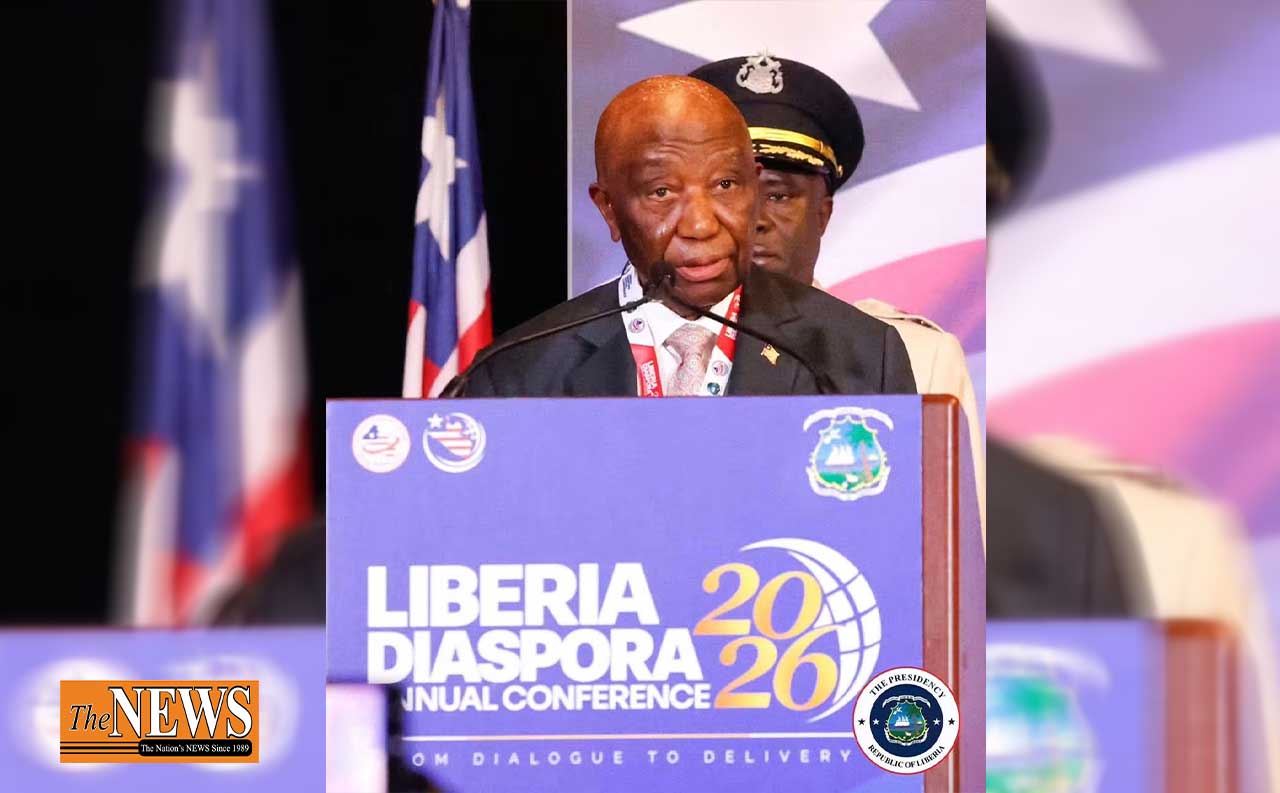
Addressing the 2nd Annual Diaspora Conference in Alexandria, Virginia, on Saturday, September 26, President Boakai said the time had come to transform years of dialogue between Liberia and its Diaspora into measurable investment, skills transfer, businesses, jobs and improved livelihoods.
Speaking under the theme, “From Dialogue to Delivery: Mobilizing the Global Liberian Diaspora for National Transformation,” Boakai said his administration no longer views the Diaspora as observers of Liberia’s affairs but as “full stakeholders” in the country’s future.
The President described Liberians abroad as Liberia’s “16th County” and the “Fifth Estate,” citing their knowledge, skills, capital, professional networks, advocacy and international experience as resources that can significantly contribute to national development.
But he warned that the relationship must move beyond talk. “From Dialogue to Delivery means moving from resolutions to responsibilities; from intentions to implementation; and from annual conferences to year-round partnership,” Boakai declared.
He challenged participants to examine the nine recommendations adopted during last year’s Diaspora Conference, asking what had been accomplished, what remained unfinished and which institutions were responsible for delivering the next results.
Boakai pointed to what he described as progress, including support for the establishment of a Legislative Diaspora Caucus, increased support for the Office of Diaspora Affairs through the national budget and efforts to establish a stronger legal and institutional framework for Diaspora engagement.
He said his government was working to create systems that would allow Liberians abroad to contribute their expertise, philanthropy, partnerships and investments more effectively and with greater confidence.
“Government cannot ask you to invest, return, serve, or transfer your expertise without accepting its own responsibility to create the conditions in which those contributions can succeed,” Boakai said.
The President said Liberia must make returning home, investing, transferring expertise and establishing partnerships more practical, predictable and worthwhile. He acknowledged the longstanding contributions of Liberians abroad through remittances, noting that Diaspora members have for decades paid school fees and medical bills, built homes, financed businesses and supported communities during national emergencies.
However, he said the next phase of engagement must go beyond family support and remittances. “The next stage of Diaspora engagement must complement remittances with productive investment, skills transfer, and institution building,” Boakai said.»
Boakai called on Liberian professionals abroad to establish practical partnerships with institutions at home, urging doctors to work with hospitals and medical schools, educators with schools and universities, engineers with infrastructure programs, technology professionals with Liberia’s digital transformation initiatives and entrepreneurs with Liberian businesses.
He also cited the Maryland–Liberia partnership as an example of the potential for Diaspora-led cooperation in trade, education, agriculture, technology, infrastructure, workforce development and investment.
But he cautioned that such partnerships should not be judged by agreements and signatures alone. Their success, he said, must ultimately be measured by completed projects, businesses created, jobs generated and lives improved.
The President outlined five practical commitments for the Diaspora, beginning with stronger organization and coordination among Diaspora organizations, professionals, businesses, women, youth and Liberian diplomatic missions.
He also called for mechanisms to connect the skills of Liberian professionals abroad with national needs through teaching, mentoring, advising, volunteering and specialized services.
On investment, Boakai urged Diaspora capital to be directed toward productive ventures through credible projects, professional due diligence, transparent rules and reliable investment mechanisms.
He further called for greater investment in the next generation through internships, mentorship, innovation, cultural exchanges and opportunities for young Liberians abroad to visit, serve and invest in Liberia.
The President also demanded measurable delivery, insisting that major recommendations from the conference should have a lead institution, partner, timeline and measurable result. “When we meet again, we should have an implementation scorecard showing what was promised, what was delivered, what was delayed, and why,” he said.
Boakai appealed to Liberians abroad to overcome political and personal divisions, arguing that disagreement should not prevent citizens from working together for the national interest. “We can disagree on politics, policies, personalities, and priorities without allowing those disagreements to destroy our common purpose,” he said.
He called for a Diaspora capable of debating vigorously while still cooperating, criticizing constructively while contributing, and demanding accountability while accepting responsibility.
With Liberia serving on the United Nations Security Council during the 2026–2027 term, Boakai said the Diaspora could also play a greater role in strengthening Liberia’s international presence.
He described Liberians abroad as bridges between Liberia and the countries where they live, saying their universities, businesses, professional institutions and community networks can create opportunities for investment, education, technology, tourism and development cooperation. “Diaspora diplomacy is not a substitute for the work of government. It is a force multiplier for the work of the Republic,” Boakai said.
The President ended with a direct appeal to Liberians abroad to participate in Liberia’s development regardless of whether they can return permanently. “To those who can return permanently, we welcome you. To those who can return for a season of service, we welcome you. And to those who cannot return now but can contribute from where they are, your contribution is equally part of our national effort,” he said.
Boakai said Liberia needs the skills, knowledge, capital, networks, experience and ideas of its citizens abroad, stressing that the country must translate patriotism into practical national development. “Let us turn patriotism into participation; participation into projects; and projects into measurable improvements in the lives of our people,” he declared. He concluded by calling on Liberians at home and abroad to “Think Liberia, Love Liberia, and together Build Liberia.”