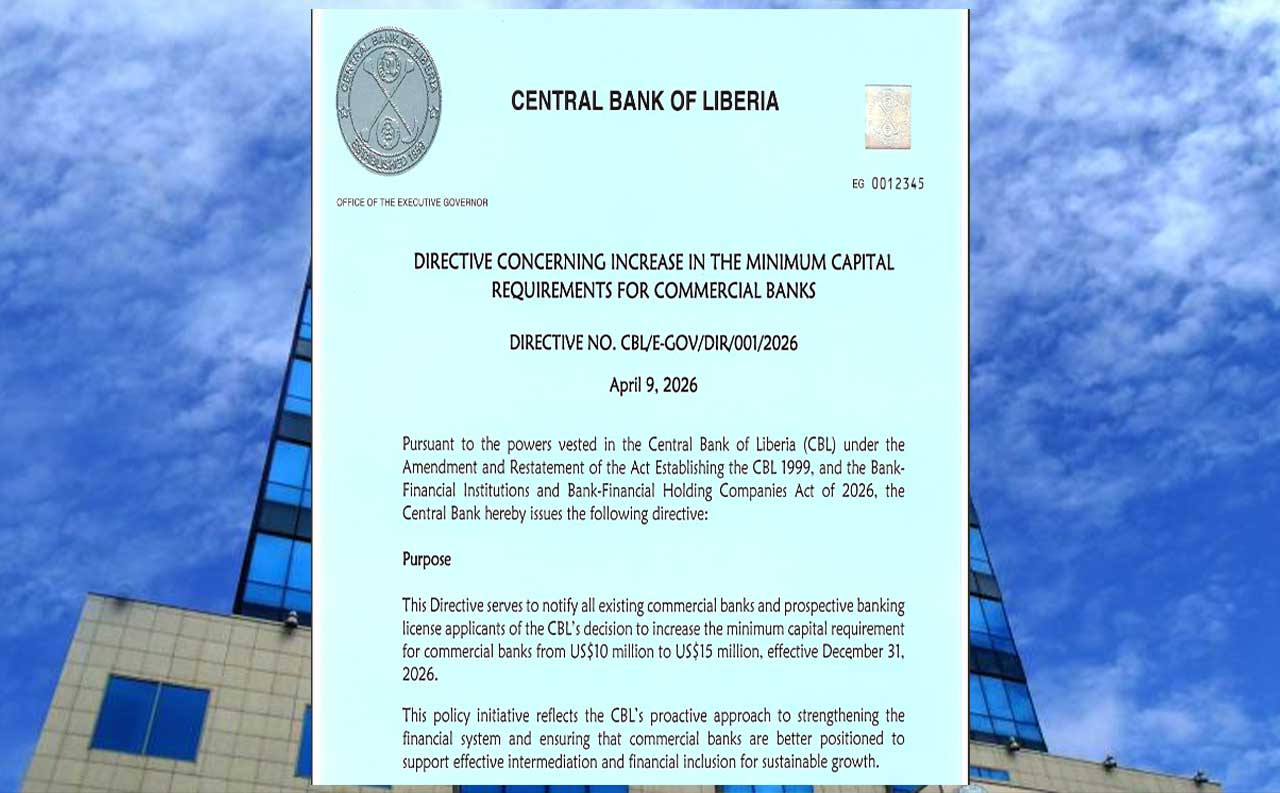
The Central Bank of Liberia (CBL) has issued a new directive, increasing the minimum capital requirement for commercial banks from US$10 million to US$15 million. Issued on April 21, 2026, in Monrovia, this Directive increases the Minimum Capital Requirement for Commercial Banks as a market filter for well-resourced investors to enter the banking sector, leading to fewer, but more robust and well-capitalized institutions.
The Directive (No. CBUE-GOV/DIR/001/2026), issued under the authority of the Amendment and Restatement of the Act Establishing the Central Bank of Liberia 1999 and the Bank Financial Institutions and Bank-Financial Holding Companies Act of 2025, will take full effect on December 31, 2026, following a structured, phased implementation period.
The CBL emphasized that the policy is a proactive and forward-looking reform designed to ensure that commercial banks are adequately capitalized to support economic expansion, financial intermediation, and inclusion. “This measure reflects the Central Bank’s commitment to maintaining a sound, stable, and efficient financial system capable of withstanding both domestic and external shocks,” said CBL Executive Governor, Henry F. Saamoi.
Key Policy Objectives
The increase in minimum capital is anchored on several strategic priorities:
- Enhancing Financial Sector Resilience: A stronger capital base will enable banks to absorb potential losses arising from economic shocks, including exchange rate volatility and global market uncertainties.
- Promoting Financial Deepening and Stability: Well-capitalized banks will be better positioned to extend larger credit facilities, support productive sectors, and invest in innovative financial services, thereby strengthening long-term economic growth.
- Encouraging Responsible Market Participation: The directive is expected to attract serious and well-resourced investors, leading to a more efficient and competitive banking landscape with fewer but stronger institutions.
- Supporting Digital Transformation and Innovation: Higher capital levels will enable banks to invest in modern financial technologies, cybersecurity systems, and fintech partnerships critical to Liberia’s evolving digital financial ecosystem.
- Improving Public Confidence: Increased capital buffers will enhance depositor and investor confidence, reinforcing trust in the banking system’s ability to withstand financial disruptions.
Phased Implementation Timeline
To ensure a smooth transition, existing commercial banks will comply with the new capital requirement over a three-year period, which includes the following:
- US$11 million by December 31, 2026
- US$12.5 million by December 31, 2027
- US$15 million by December 31, 2028 (Final Requirement)
Requirements for New Applicants
All prospective commercial banking license applicants, including those with pending applications, will be required to meet the full US$15 million minimum capital requirement prior to license issuance.
Compliance and Enforcement
Meanwhile, strict compliance with this Directive will be enforced as required by law. Institutions that fail to meet the new requirements may face regulatory actions, including:
- Restrictions on expansion activities
- Suspension of certain banking operations
- Possible revocation of banking licenses.
At the same time, the Central Bank notes that implementation will be phased and consultative, allowing banks sufficient time to adjust their capital structures and align their business models with the new regulatory framework.