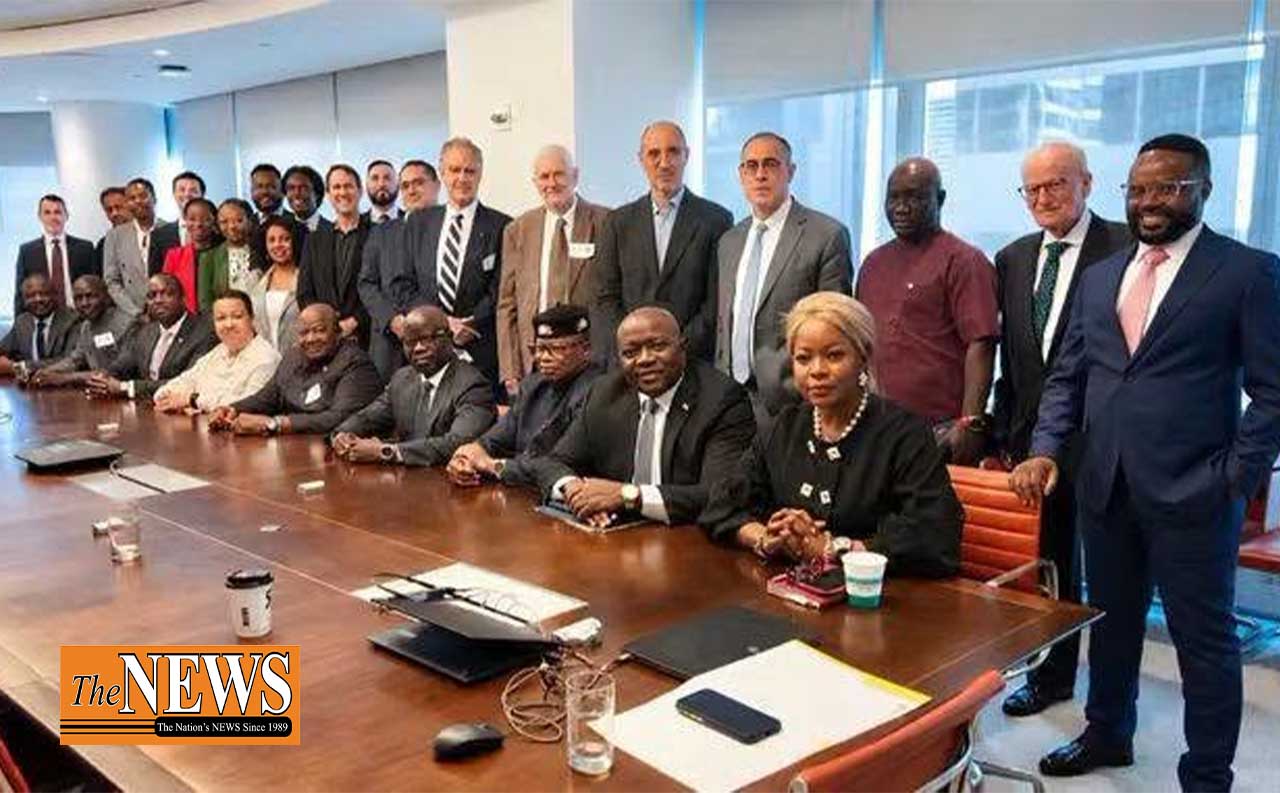
Liberia has intensified its drive to attract private capital from the United States and other international markets, presenting a broad range of investment opportunities in mining, energy, agriculture, infrastructure, manufacturing and digital development at a high-level Liberia Investment Dialogue held on the margins of the United Nations General Assembly. The investment roundtable was organized by Madam MacDella M. Cooper and co-organized by New Africa Capital, bringing together senior Liberian government officials, advisers, private-sector investors and investment intermediaries for a focused conversation on how to convert Liberia’s economic opportunities into concrete investments.
Unlike conventional conferences built around lengthy panels and presentations, organizers deliberately structured the session as a direct investment dialogue, with emphasis on tangible partnerships, follow-up actions and measurable results in the coming months. The country is seeking investors who are prepared to move from conversation to implementation. Minister of Finance and Development Planning Augustine K. Ngafuan presented Liberia’s improving macroeconomic position, describing the country as stable, reforming and increasingly open to serious private-sector investment.
The International Monetary Fund has independently projected Liberia’s real GDP growth at approximately 5.5 percent in 2026, with growth supported by mining, construction and manufacturing. The IMF also reported that inflation averaged about 4.5 percent during the first half of 2026, while the Liberian dollar remained broadly stable.
The government’s recent announcement that domestic revenue collections had surpassed US$1 billion was also presented as an important indicator of Liberia’s expanding fiscal capacity. President Joseph Nyuma Boakai said the milestone marked the first time in the country’s history that domestic revenue exceeded US$1 billion in a single year without borrowing or foreign aid.
For investors, the government emphasized that the objective is not simply to increase economic growth, but to generate jobs and expand productive capacity through agriculture, agro-processing, manufacturing, electricity, roads, ports, logistics and digital infrastructure. A major public-private partnership road project valued at more than US$360 million was cited as an example of the type of private-sector participation Liberia is seeking to expand. Mining: From Extraction to Value Addition, mining emerged as one of the most significant areas of opportunity.
The Minister of Mines and Energy outlined Liberia’s established iron ore, gold and diamond industries while pointing to considerable opportunities that remain unexplored because of gaps in detailed geological and geoscientific data.
Investors were encouraged to look beyond traditional mineral exports toward critical and industrial minerals, including tin, tantalum, lithium, rare earth elements, bauxite and coastal heavy mineral sands. The government also stressed the importance of moving Liberia’s mining industry up the value chain, from extraction and export toward processing, beneficiation, technology transfer and local industrial development. The presentation positioned Liberia’s mineral wealth not merely as a source of government revenue, but as a potential foundation for broader industrialization.
Energy Identified as a Gateway to Industrialization: Energy was repeatedly linked to Liberia’s industrial ambitions. The government highlighted a national target of reaching approximately 75 percent electricity access by 2030, with an estimated 100,000 new connections annually. Liberia’s hydropower and river potential, including opportunities along the St. Paul and Sindon River corridors, were presented as part of the country’s broader energy investment case.
But officials acknowledged that generation alone cannot solve Liberia’s electricity challenge. Expansion of transmission and distribution infrastructure will be necessary to move electricity to communities, mines, factories and other major industrial users. The message to investors was therefore broader than simply building power plants: Liberia needs capital across the entire electricity value chain.
Rail Infrastructure Takes Center Stage. Another major investment issue was Liberia’s rail infrastructure. The Buchanan-Yekepa railway, stretching roughly 240 kilometers, was discussed as a strategic asset capable of supporting multiple mining operations and broader economic activity.
Government officials said Liberia is moving toward a National Rail Authority model designed to facilitate multi-user access to the railway. The transition from the existing user-operator arrangement is expected to continue through 2029, with the stated objective of preventing the rail system from being effectively locked to a single mining operator and instead creating access for multiple users.
For investors, the rail discussion underscored a central reality of Liberia’s investment environment: mineral resources alone are insufficient without the transportation infrastructure required to move them efficiently to market.
Agriculture also featured prominently in the investment discussions. The Minister of Agriculture described the sector as one of Liberia’s largest potential engines of economic transformation, emphasizing opportunities not only in primary production but throughout agricultural value chains.
The discussion focused on issues including land access, agricultural financing, productivity, processing, storage, transportation and market access. The government’s investment message was aimed at encouraging investors to look beyond raw agricultural production toward agro-processing and value addition, where greater employment and domestic economic benefits can potentially be generated.
A Deliberate Push for Private Capital: The investment dialogue comes as the Liberian government continues efforts to deepen engagement with international investors and development partners during the UN General Assembly period.
The government has recently emphasized electricity, infrastructure, private-sector growth and responsible investment as central elements of its development strategy. The New York dialogue therefore served as a bridge between Liberia’s economic policy ambitions and the international capital that could help finance them.
Also in attendance were Amb. Jeanine Coope, Chief Executive Officer, Liberia Carbon Market Authority (CMA), Dr. Emmanuel K. Urey Yarkpawolo, Executive Director/CEO, Environmental Protection Agency (EPA); Christian Dunbar, Senior Advisor to President Joseph Nyuma Boakai for Investment Financing & Development; Sekou M. Kromah, Minister of Posts and Telecommunications/Postmaster General, Ministry of Posts and Telecommunications; Dr. Augustine Konneh, and Senior Economic Advisor to President Joseph Nyuma Boakai.
For the organizers, the central question was not whether Liberia has investment opportunities. It was how quickly those opportunities can be converted into bankable projects, partnerships, financing commitments and jobs.
With mining, energy, agriculture, infrastructure, manufacturing and digital development all placed on the table, Liberia’s pitch to American and international investors was effectively a call to move beyond interest and into action. The next few months, organizers emphasized, should be measured not by how many people attended the dialogue, but by how many investment conversations become real projects on the ground in Liberia.