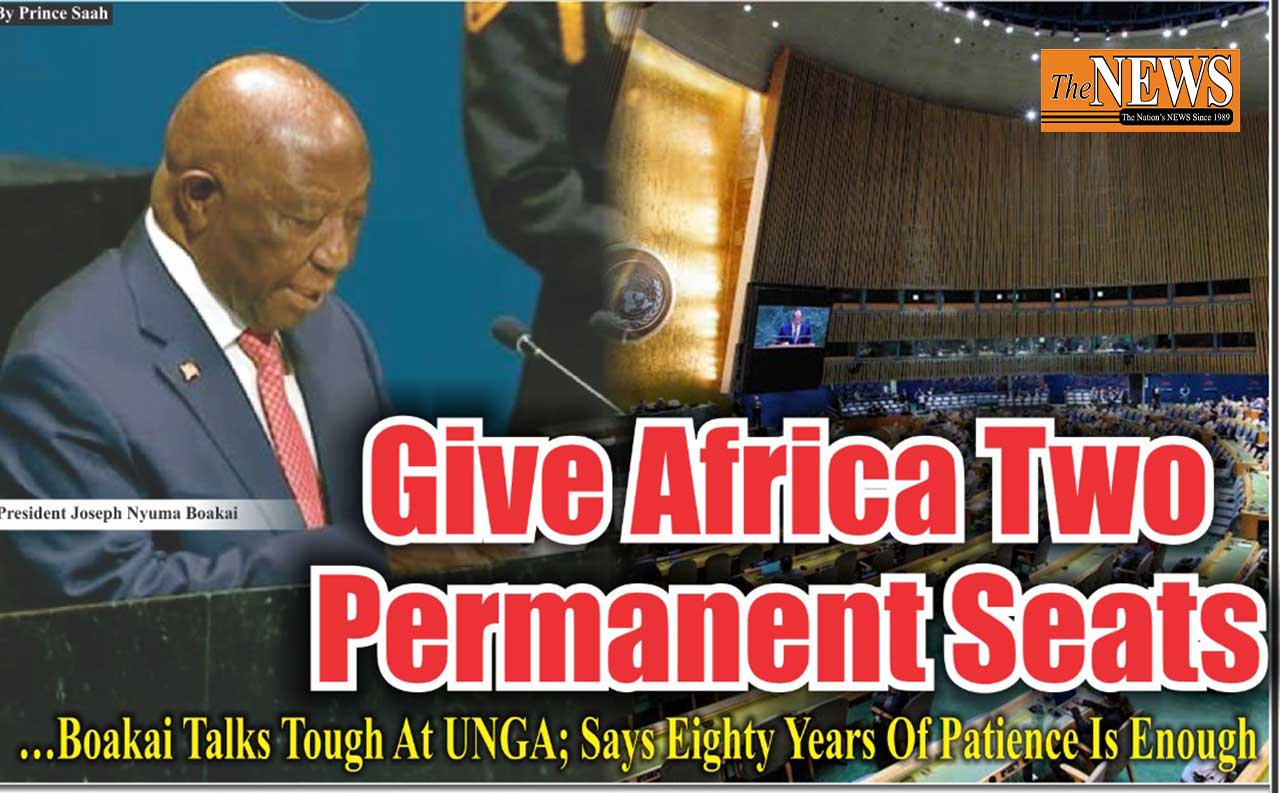
President Joseph Nyuma Boakai has informed world leaders attending the 81st Session of the United Nations General Assembly that eighty years of patience is enough. According to the Liberian leader, the time for structural reform of the United Nations is now. Speaking on reforming global governance and correcting a historic injustice, President Boakai noted, Mr. President, eighty years of patience is enough. The time for structural reform is now.
He added, “While we welcome the UN80 Reform Agenda to make this Organization agile, efficient, and accountable, true reform must address a core structural issue: the UN Security Council.
President Boakai reminded world leaders that Africa is home to 1.5 billion people and accounts for nearly one-third of UN membership. He added, “Yet eighty percent of Security Council mandates concern African peace and security, while Africa remains without a single permanent seat on the organ responsible for global peace. This historical injustice is no longer tenable.”
Under the general theme: “Restoring Trust, Managing Transformation: A United Nations that Delivers for All,” President Boakai reaffirmed Liberia’s support for the Common African Position on the Proposed Reform of the United Nations Security Council.
He noted, “We celebrate the presentation of the African Model during the recent Intergovernmental Negotiations, which advances us toward text-based negotiations. Africa demands no fewer than two permanent seats, with all accompanying rights and responsibilities, including the veto so long as it exists, as well as additional non-permanent seats. Correcting this imbalance is not a favor to Africa; it is necessary to restore the United Nations’ trust, credibility, and legitimacy.”
“Mr. President, the choice before the Eighty-First General Assembly is stark. We can allow multilateralism to drift toward irrelevance, or we can change course and act boldly to restore trust, credibility, and legitimacy. Liberia’s journey, from civil conflict to constitutional democracy and from broken institutions to accountable governance, shows what is possible when nations commit, deliberately and consistently, to restoring trust and managing transformation. As we did in San Francisco in 1945, Liberia is ready, together with all member states, to save mankind from the scourge of war, guarantee human dignity, and leave no one behind,” the Liberian leader said.
Encouraging world leaders, President Boakai noted, “Let us leave this Assembly committed to a United Nations that not only deliberates on crises but also resolves them, that restores trust through results, protects the vulnerable, honors the rights of all nations, and secures a peaceful planet for generations to come.”
He added that the theme of the 81st Session of the General Assembly of the UN, “Restoring Trust, Managing Transformation: A United Nations that Delivers for All,” frames a lingering crisis of legitimacy and relevance that demands urgent attention.
“Trust in multilateralism is broken and needs to be restored, not because the principles of the Charter are no longer relevant, but because we have applied them inconsistently and selectively, fueling global fragmentation. Our answer to that fragmentation cannot be less multilateralism. It must be better multilateralism,” Boakai said.
President said, “Eighty years ago, Liberia was among only four African nations to sign the Charter establishing the United Nations, believing then, as we do now, that a peaceful world rests on international law, respect for human rights and dignity, and a commitment to development. Having risen from the ashes of conflict to become a resilient democracy, Liberia is living proof that dialogue can overcome division and that institutions can be rebuilt.”
He said this same spirit defines their national governance today. “Under my Administration, Liberia is strengthening public accountability, ensuring prudent financial management, intensifying the fight against corruption, and supporting the judiciary in rebuilding citizens’ confidence in the institutions that serve them,” he told the gathering of world leaders on Thursday, September 24, 2026, in New York.
President Boakai reminded them that without peace, development is impossible, and without inclusive development, peace is an illusion. He added that across the raging theater of conflict, innocent civilians continue to pay the unacceptable price of war, adding, “We renew our call for an immediate end to all hostilities, unhindered humanitarian access, and full respect for international humanitarian law.
He told the gathering that prevention must be at the heart of international peace and security. Investing in preventive diplomacy, mediation, and early warning is not only morally imperative but also fiscally prudent: the cost of preventing a war pales in comparison to the cost of rebuilding a broken society.
“As a current member of the United Nations Security Council, Liberia is putting these principles into practice while confronting evolving threats across West Africa, including transnational organized crime, cyber warfare, and illicit narcotics trafficking along maritime corridors in the Gulf of Guinea. Through our Joint Security forces, we are tightening the vise on transnational drug cartels. No nation can police global criminal networks alone, so we call on international partners for targeted support in coast guard surveillance, intelligence sharing, and port security technologies,” President Boakai, among other things, concluded.