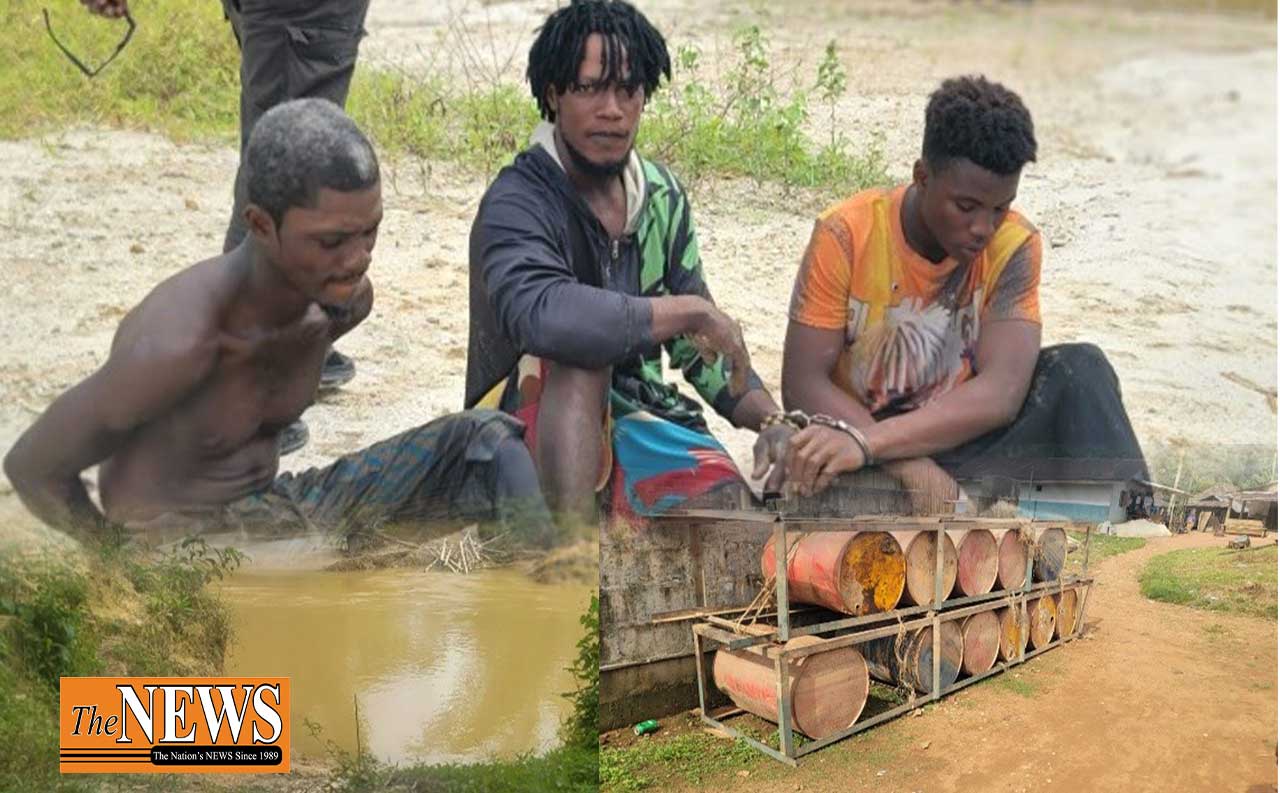
Liberia’s crackdown on illegal gold mining has intensified, with eight people arrested following a joint security operation targeting unauthorized mining activities allegedly linked to Ghanaian nationals and their Liberian collaborators in Gonelor, Grand Cape Mount County.
The operation, involving the Liberia Immigration Service, Environmental Protection Agency (EPA), Ministry of Mines and Energy, Liberia National Police, and Armed Forces of Liberia, targeted two mining sites where authorities reportedly uncovered extensive environmental damage and evidence of unauthorized gold extraction.
Colonel Ashford Peal, Head of Operation for Protect Our Resources Taskforce (PORT) who spoke with journalists during the operation on Thursday, October 29, 2026, said the security team acted on intelligence that foreign nationals were engaged in illegal mining activities and allegedly mistreating Liberians working at the sites. “We have arrested about eight of them,” Peal disclosed, adding that military personnel were still bringing other suspects across the water as the operation continued.
According to him, the security team observed large excavated pits and equipment allegedly used in activities that could contaminate nearby waterways, raising concerns about the potential consequences for surrounding communities and aquatic life.
However, Peal warned that substances used in gold extraction could threaten fish populations and make nearby water sources unsafe for community use. “The minerals they put in this water are going to kill the fishes,” he said, expressing concern over the possible long-term effects of the mining activities on the environment.
Speaking further, he disclosed that authorities intend to seize the machines discovered at the sites and turn them over to the Ministry of Mines and Energy for appropriate action. “The arrested individuals are expected to undergo further investigation to establish the ownership of the operations, identify those financing the activities, and determine whether a wider network is facilitating illegal mining in the county,” Col. Peal explained.
Moreover, interviews with some of the individuals working at the mining sites revealed that at least some operators lacked the necessary government authorization to conduct mining activities in Liberia.
One miner, identified as Frank, who said he supervises five Liberian workers, admitted that he had not obtained official permission from the government to engage in mining.
Frank also acknowledged that he was not operating under a registered company, although he claimed that the miners made monthly payments through local arrangements connected to their activities.
He told journalists that the group had been paying what he described as monthly dues, including a reported L$20,000 payment to a local money agent. However, Frank could not provide receipts or official documentation to establish the legal basis for the payments.
He said the miners had previously discussed the issue of receipts with local authorities and expected that documentation would eventually be provided. His account has raised questions about who was collecting the money, under what authority the payments were being made, and whether any government institution had approved the mining activities.
But he further acknowledged that the government had not issued him documents authorizing his operations, while claiming that officials had previously visited the area and warned miners against using certain machines. Despite the warnings, he said the miners sometimes appealed to authorities to allow them to continue working, arguing that mining was their means of survival.
Another miner, identified as George Koffa, said he had been working at the site for approximately one month after joining individuals already engaged in gold mining. Koffa identified a person he referred to as “Ghana Man” as the individual associated with his work but said he did not know the person’s whereabouts when journalists questioned him.
He confirmed that the operation was intended to recover gold and acknowledged awareness of concerns about the potential harm illegal mining could cause to Liberia and its natural resources.
Speaking, Koffa explained that his earnings depended on the quantity of gold recovered rather than a fixed daily salary.
The interviews suggest that Liberian workers are participating in the mining activities alongside foreign nationals. However, the actual ownership, financing, and management structure of the operations remain unclear.
For his part, Col. Abraham Kromah, Head of the Taskforce told journalists that investigations will be necessary to identify those behind the activities, particularly individuals who reportedly fled before or during the security operation.
Col. Kormah emphasized that mining activities in Liberia must comply with the country’s mining laws and environmental regulations, regardless of whether operators are Liberians or foreign nationals. However, he said individuals interested in mining to seek the appropriate authorization from the Ministry of Mines and Energy and satisfy relevant environmental requirements before commencing operations. The head of the Taskforce referenced the country’s mining authorization categories, including Class B and Class C licenses, stressing that proper licensing and government oversight are necessary to prevent uncontrolled mining activities. “We cannot allow this because there will be no control,” he said, explaining the decision to deploy security personnel to the affected locations.
He also warned that the government would continue gathering intelligence to locate individuals who escaped and prevent the illegal operations from resuming after security personnel leave the area.
The crackdown comes amid growing concerns over unauthorized mining activities across Liberia and their impact on the country’s natural resources, particularly rivers, streams, agricultural land, and the livelihoods of surrounding communities.