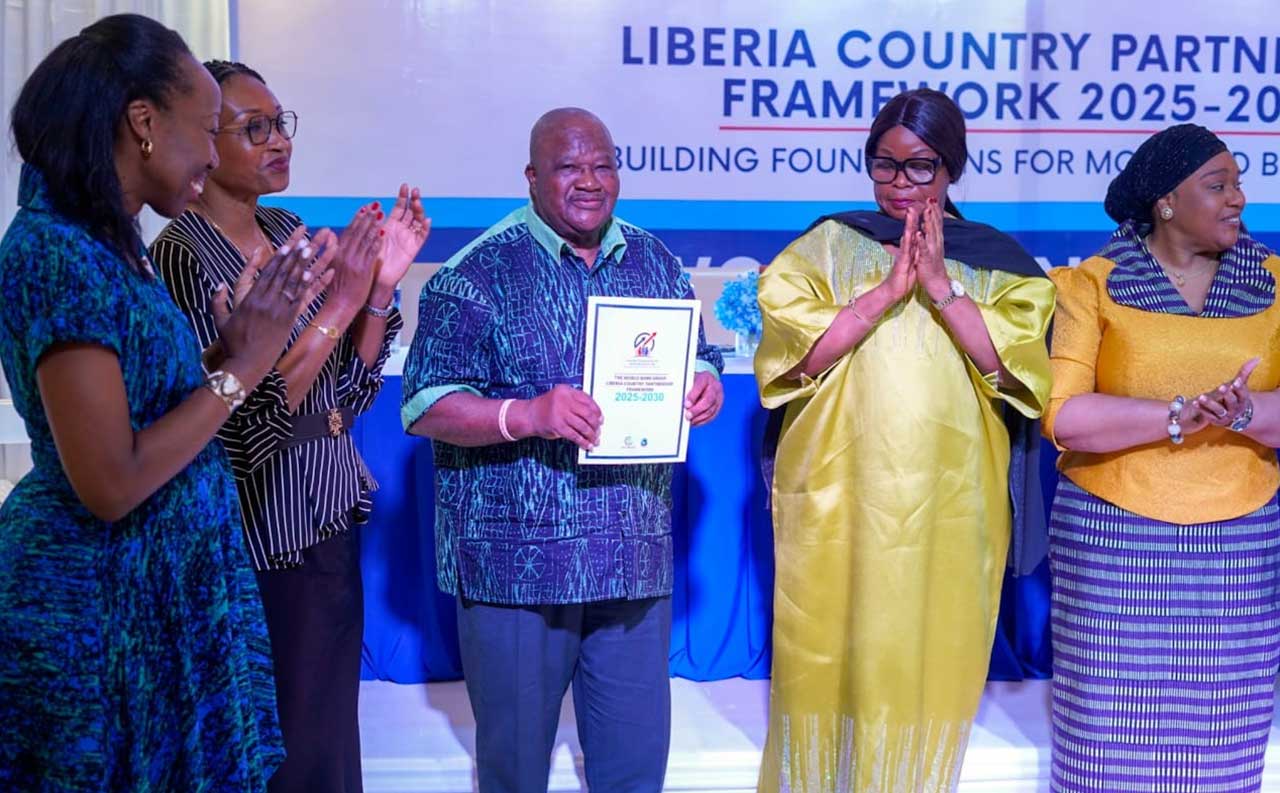
The World Bank Group (WBG), in partnership with the Government of Liberia, has launched its new Country Partnership Framework (CPF) for Liberia. The CPF supports more and better jobs by focusing selectively on four essential outcome areas: education, energy access, accountable and transparent governance, and private investment, with a focus on agroindustry and forestry.
According to a release, the launch was held on Wednesday, December 3, at the Ellen Johnson Sirleaf Ministerial Complex in Oldest Congo Town, bringing together senior officials of the Liberian Government, the World Bank Group, development partners, the private sector, civil society actors, youth groups, and other relevant stakeholders.
International Finance Corporation (IFC) Division Director for Gulf of Guinea Cluster (West Africa 2), Ms. Nathalie Kouassi Akon, described the event as “a signal that Liberia is ready to transform its potential into progress, to turn national aspiration into tangible impact for its people.” Madam Akon said the CPF is designed to help Liberia meet some of its deepest, most urgent needs, including creating more and better jobs, strengthening essential services through better governance, expanding opportunities for women, youth, and MSMEs, building resilience, and attracting investment where most needed. “Job creation sits at the center of everything we do. Jobs change lives, build dignity, stabilize societies, and are how countries turn growth into opportunity,” she added.
World Bank Liberia Country Manager Georgia Wallen said the new World Bank Group (WBG) Country Partnership Framework (CPF) aims to help Liberia achieve its national development plan – the ARREST Agenda for Inclusive Development (AAID), which is the last leg of the race to Liberia’s Vision 2030.
Ms. Wallen highlighted few things that the public needs to know about the significance of the CPF, stating that the WBG partnership with Liberia over the next five years will have one aim: building foundations for more and better jobs, which she termed as the pathway to delivering AAID and pursuing the WBG goals to end extreme poverty and promote shared prosperity on a livable planet.
To help build foundations for more and better jobs, Wallen said the Group will focus on scaling up results in four key outcome areas tailored to the Liberian context and essential for job creation. These are: (i) reducing learning poverty; (ii) increasing energy access, (iii) promoting transparent and accountable governance; (iv) increasing private investment – including in agroindustry and sustainable forest economies.
“Our program will focus on achieving results on these four outcomes. We will integrate resilience into all our efforts, including climate, fiscal, and social resilience, with a focus on youth and women. All we do (from foundational learning to investments in women’s economic empowerment, lighting up health centers, boosting access to digital services, promoting an SME Accelerator) will have a unified focus on laying foundations for jobs,” she said.
According to her, no one runs or wins a relay race alone; therefore, strategic partnerships will be decisive. She said that the CPF was developed through dialogue and consultation with the Government of Liberia as well as development partners, youth, private sector representatives, academia, amongst others, saying, “We started the CPF in a consultative way, and we will continue to maintain a consultative, partnership approach.”
Senior Advisor to President Joseph Nyumah Boakai, Dr. Augustine Konneh, on behalf of the Liberian Government, said that Liberia recognizes and celebrates the World Bank’s enduring commitment to its national renewal, indicating that the Bank has been a cornerstone in the country’s economic recovery effort, and its support continues to empower the government to make progress where it was once impossible.
Dr. Konneh is convinced that the Country Partnership Framework aligns with national development strategy, the ARREST Agenda. ‘This is the type of partnership we want: one where national priorities are respected, where collaboration is strategic, and where development is driven by the aspirations of Liberians themselves,” he told the gathering.
Finance and Development Planning Minister Augustine Kpehe Ngafuan welcomed the launch of the CPF, adding that “These next five years are decisive for reaching our 2030 goals. The CPF arrives at the right time and can help us accelerate progress if we focus on results, efficiency, and accountability.”
“We value the World Bank’s support for resilient, inclusive, and accountable development. The challenges we face, post-conflict recovery, economic shocks, and climate risks, require a partnership that combines financing with stronger institutions, better systems, and empowered communities,” Minister Ngafuan emphasized.
The CPF aims to strengthen the growing collaboration between Liberia and the World Bank Group via a “One WBG” approach that emphasizes collaboration among the Group’s different institutions (IDA, IBRD, IFC, and MIGA) to address Liberia’s development challenges more effectively. It increases focus on enabling private sector development through key corporate initiatives – particularly Mission 300 and the WBG’s agribusiness scale-up – to catalyze partnerships and crowd in financing.
The new CPF is aligned with the WBG mission of ending extreme poverty and promoting shared prosperity on a livable planet. It aims to deliver catalytic and selective support for Liberia’s new AAID, maximizing the One WBG value proposition. The CPF integrates feedback from dialogue with key stakeholders, including the government, the private sector, civil society, academia, and other development partners.