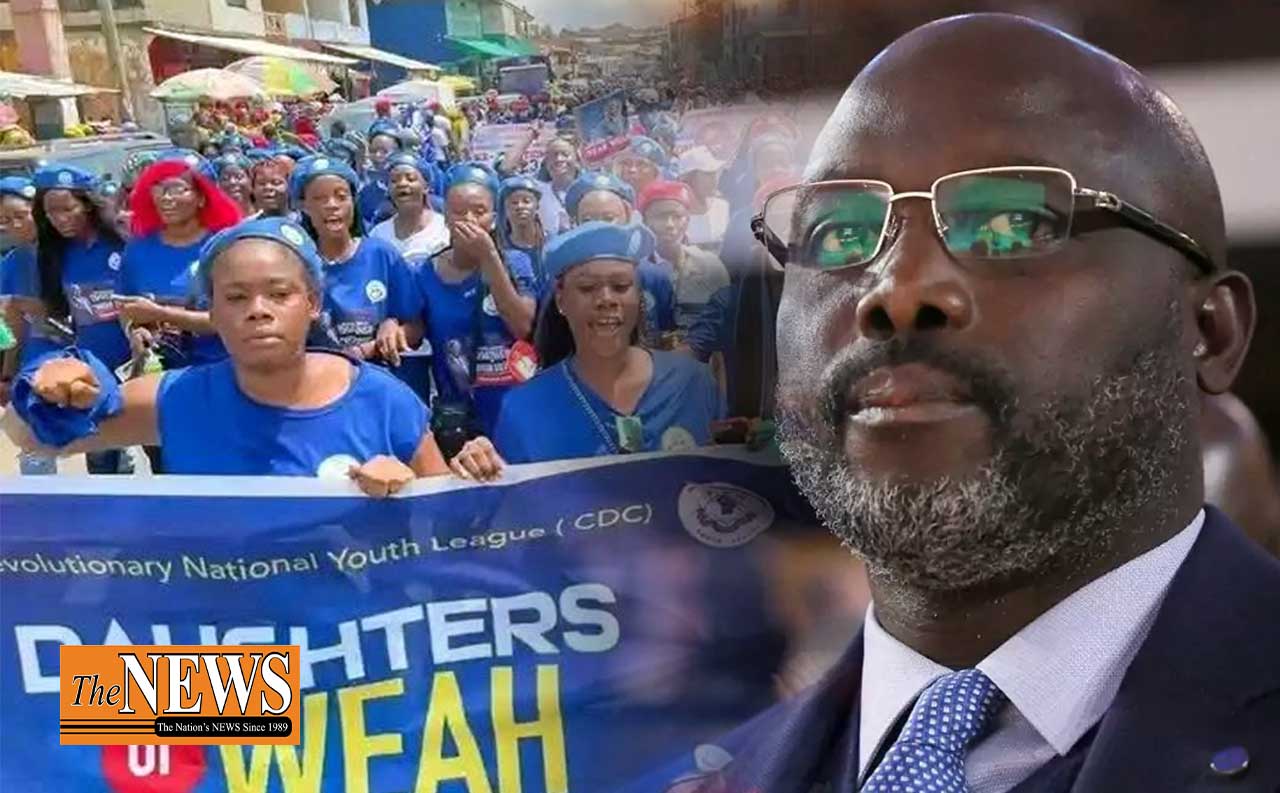
Supporters and well-wishers yesterday turned out in numbers at Roberts International Airport to warmly welcome former President George Weah as he arrived in Liberia.
Liberia’s main opposition leader and former President of Liberia George Manneh Weah received a heroic welcome from thousands of his supporters and partisans yesterday as he returned to the country via the Roberts International Airport (RIA) to prepare for the pending 2029 Presidential and legislative Elections.
The former Liberian leader touched down at about 5:30 PM yesterday evening Liberia as his thousands of supporters to his arrival at the RIA.
Weah has since declared his intention to contest the 2029 presidential and legislative elections after being defeated by now President Joseph Nyuma Boakai in the 2023 presidential run-off. He served for just one term and lost to the Unity party standard-bearer, Boakai.
Weah returned to Liberia yesterday Wednesday, September 2, 2026, with an aggressive political agenda previously rallying Liberians against the Boakai-Koung administration and begin positioning himself for a return to the presidency in 2029.
Weah, who governed Liberia from 2018 to 2024, arrived through the Roberts International Airport (RIA) following visits to the United States of America and other countries, returning home with his political intentions clearly declared.
While in the United States, the former President held a retreat with members and supporters of his Congress for Democratic Change (CDC), where he declared his intention to contest the 2029 presidential election.
The former President later touched down at about 5:30 PM yesterday evening Liberia as his thousands of supporters to his arrival at the RIA. Thousands of his partisans, supporters as well as sympathizers turned out at the Roberts International Airport (RIA) to see their political leader return to the country following months of travels.
Meanwhile, report gathered say Joint security personnel at Roberts International Airport denied dozens of CDC supporters, who stormed the RIA to receive former President Weah upon his return to Liberia, access to the main route leading to the airport.
According to joint security authorities, the decision was part of security measures aimed at ensuring the former president’s safety upon his return to Liberia. Dozens of CDC supporters remain at the joint security checkpoint as they awaited the arrival of Mr. Weah.
“George Weah, we are sorry, we wronged you,” CDC supporters chanted as they awaited the former football star turned president’s arrival. Supporters of the opposition Coalition for Democratic Change (CDC) gathered as they awaited the arrival of former President George Manneh Weah, with some using the occasion to express dissatisfaction with President Joseph Nyuma Boakai’s administration.
Amid singing and political chants, some supporters declared that they regretted voting Weah out of office in the 2023 presidential election. “Boakai has failed us. George Weah, we are sorry, we are sorry oooh, our pa. We wronged you,” some supporters chanted.
The remarks reflect the views of the participating CDC supporters and should not be interpreted as representing the position of all Liberians.
Weah’s return comes after he declared his intention to contest the 2029 presidential election, seeking another opportunity to lead Liberia following his defeat to President Boakai in 2023.
CDC officials and supporters have been mobilizing ahead of his arrival, portraying the former President’s return as an important moment in the party’s effort to rebuild and prepare for 2029.
The gathering also comes amid increasingly heated exchanges between the ruling Unity Party and opposition figures over governance, the economy, the drug crisis and ongoing criminal proceedings involving former Vice President Jewel Howard-Taylor.
With supporters already chanting for his political comeback, Weah’s return is shaping up as an early show of strength for the CDC more than three years before the 2029 elections.
Prior to his return to Liberia, the former president said that upon his return to Liberia, he would rally Liberians against the government of President Joseph N. Boakai and Vice President Jeremiah Kpan Koung, signaling a potentially more confrontational phase of opposition politics.
The pronouncement places the former President on a direct political collision course with the Boakai-Koung administration and could mark the beginning of an early mobilization campaign more than two years before Liberians officially head to the polls.
Weah’s expected return yesterday is therefore shaping up to be more than a routine homecoming. He returns as a declared presidential contender who has openly promised to mobilize citizens against the administration that replaced him in January 2024.
His return could also energize the CDC’s political base, which has remained one of the strongest opposition blocs since the party lost state power following the tightly contested 2023 presidential runoff election.
However, Weah lost that election to Joseph Boakai by a narrow margin and conceded defeat, paving the way for Liberia’s second peaceful democratic transfer of presidential power in decades.
But nearly three years after leaving the Executive Mansion, the former President has made clear that his defeat did not mark the end of his presidential ambitions. His declaration in the United States removes much of the uncertainty surrounding his political future and potentially forces other opposition politicians considering the presidency in 2029 to reassess their calculations.
Upon his return, the former president’s pledge to rally Liberians against the Boakai-Koung administration could also intensify scrutiny of the government’s performance as the CDC seeks to capitalize on public concerns over governance, economic conditions and other national issues.
It remains to be seen what form Weah’s promised mobilization will take, what specific grievances he intends to campaign around, and how quickly the CDC will translate his declaration into organized political activities across Liberia.
For the ruling administration, Weah’s return means confronting an opposition leader who remains nationally recognizable and commands a substantial political following despite losing the presidency.
The former football superstar remains the dominant personality within the CDC and one of Liberia’s most influential political figures, particularly among grassroots supporters and young people who have formed an important part of his political base.
Before entering politics, Weah built a celebrated international football career, becoming the first African to win the Ballon d’Or before eventually turning his enormous popularity into political power.
He won the 2017 presidential election and served a six-year term, but his administration faced criticism over economic hardship, governance and allegations of corruption. Weah and his supporters have consistently defended his record, highlighting infrastructure and development projects undertaken during his presidency.
Now seeking another opportunity to govern, Weah will face the challenge of defending that record while convincing Liberians that the current administration should be replaced and that he deserves another mandate.
His promised campaign against the Boakai-Koung government could therefore become an early test of whether the political support that carried him to the presidency in 2017 remains strong enough to propel another national movement. It could equally test the Boakai administration’s ability to defend its record as it confronts increasingly organized opposition ahead of the 2029 political season.