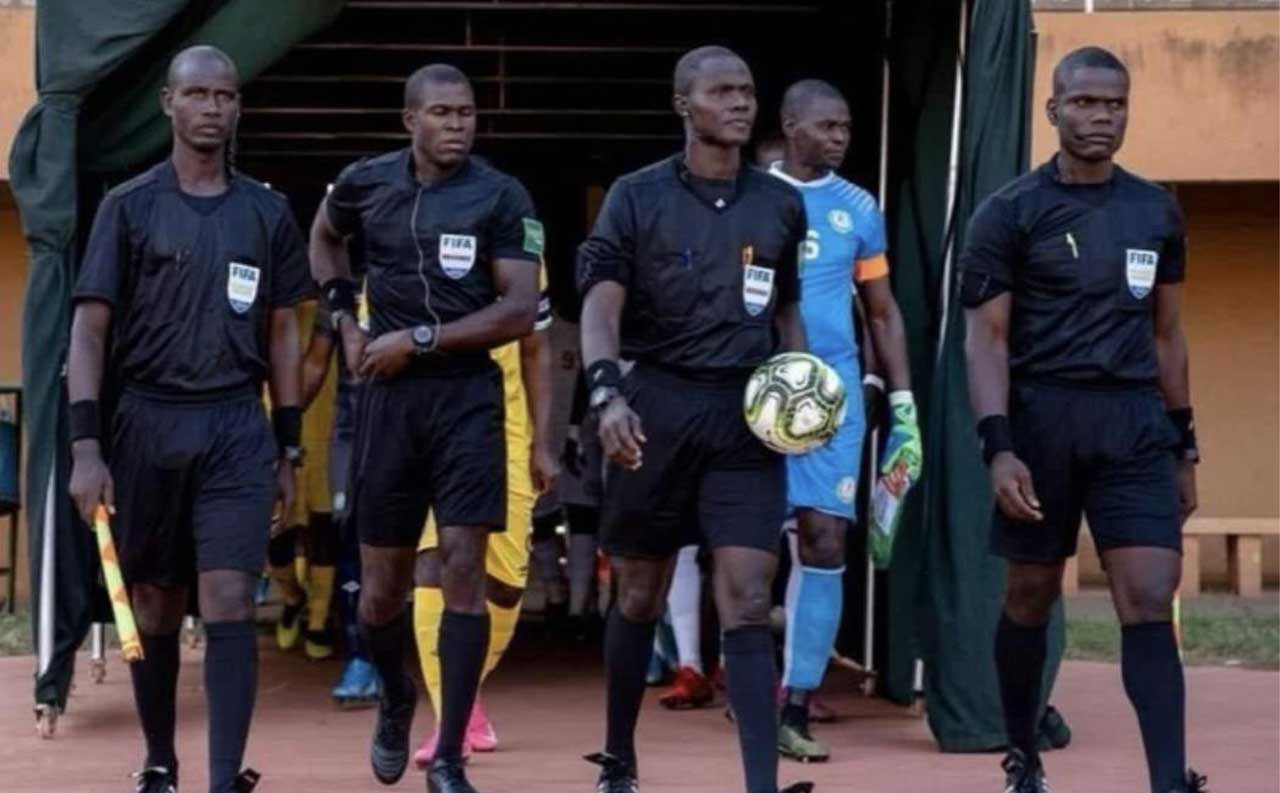
Every weekend across Liberia, football referees step onto the pitch knowing they will likely leave as the most heavily scrutinized figures in the game. While players celebrate victories, coaches dissect tactics, and supporters debate controversial moments, referees routinely remain at the center of fierce criticism long after the final whistle.
Every penalty awarded, red card brandished, or offside decision flagged quickly becomes the subject of heated arguments among club officials, fans, and entire communities. Yet, despite operating under immense pressure and hostile local conditions, Liberian match officials are making significant strides on the continental and global stages, earning high-profile appointments to major Confederation of African Football (CAF) and FIFA competitions.
This growing international reputation, however, stands in stark contrast to the grim reality they face at home, acute security threats, poor infrastructure, low financial incentives, and relentless intimidation from spectators and club stakeholders.
A Profession Under Constant Pressure
In Liberia, refereeing extends far beyond merely enforcing the Laws of the Game. A single decision can decide a league title, dictate qualification for continental tournaments, or ignite crowd violence.
These pressures are magnified exponentially during the annual National County Sports Meet, where intense county rivalry frequently transforms matches into emotionally charged, volatile encounters. Unlike players and coaches, referees work without the cushion of technical backstaff or public sympathy.
They often stand completely alone in hostile environments. Furthermore, the vast majority of Liberian referees must balance their football duties with full-time employment and family responsibilities.
Many travel long distances to officiate matches for modest match indemnities, while fighting to maintain the rigorous physical fitness standards demanded by CAF and FIFA. Insiders say the profession continues to be driven almost entirely by discipline, personal integrity, and passion rather than financial reward.
Building on a Proud Legacy
Liberia’s refereeing tradition spans more than six decades. The country’s international breakthrough came in the early 1960s when Marcel Edgar Bertin and Philip Robinson became Liberia’s first FIFA-badged referees.
Their success laid the foundation for a distinguished lineage of officials, including Mark Dormoh, Idrissa Kaba, Jerry S. Yekeh, Emmanuel Neewon, and Lamin K. Kamara, who represented the country across the continent.
In recent years, the Liberia Football Association (LFA), with financial backing from FIFA and CAF, has expanded referee development through elite training programs, physical fitness assessments, and technical education. Grassroots recruitment has also moved beyond the capital, Monrovia, into rural counties, complemented by school-based initiatives aiming to recruit young talent early.
From Volunteerism to Professional Recognition
Veteran referees recall a time when officiating offered little more than personal satisfaction. Former FIFA referee Jerry Yekeh noted that officials once struggled to obtain basic gear, often sewing their own uniforms or scouring second-hand clothing markets (bend-and-choose) for usable jerseys.
“One of our biggest challenges was simply obtaining referee uniforms,” Yekeh recalled. “To even get a physical copy of the Laws of the Game back then, you practically had to know a FIFA referee personally.”
Yekeh noted that today’s generation benefits significantly from online learning modules, structured digital assessments, and regular FIFA and CAF training seminars that were nonexistent during his era. Former FIFA referee Hassan Zinnah Corneh also reflected on the gradual improvements in referee welfare.
According to Corneh, indemnities, transportation logistics, and development programs have improved under the current LFA administration, though he acknowledged the progress is still a work in progress. He urged football authorities to further strengthen local protections and clear more international pathways for top-tier local whistlers.
Women Breaking New Ground
One of the most remarkable success stories in modern Liberian football is the rapid rise of female referees. A major glass ceiling was shattered in 2019 when Sylvina Welma Garnett became a FIFA-badged center referee, paving the way for a new wave of officials including Hannah L. Moses, Love T. Wehyee, and Tracy Chayee.
Liberia’s international stock rose further when CAF appointed an all-Liberian female officiating crew to handle a high-stakes Women’s Africa Cup of Nations (WAFCON) qualifier between Rwanda and Egypt.
Hannah Moses subsequently became the first Liberian female referee selected to officiate at the main WAFCON tournament.
“The increasing number of female referees in Liberia is a positive sign for the development of our football,” Moses said, reflecting on the milestone. “More women are stepping forward to contribute to the game, and that creates greater opportunities for female inclusion across the board.”
She emphasized, however, that continuous training is vital: “Learning should never stop. Regular assessments, refresher courses, and technical training programs are essential to maintaining high officiating standards.”
International Accolades
Top Liberian officials are now becoming fixtures in prestigious global competitions. FIFA assistant referee Joel W. Doe described his selection for the FIFA Under-17 World Cup as a career-defining moment.
“When I was selected for the FIFA U-17 World Cup, I became emotional because it was the first time in Liberia’s football history that a local referee had been selected for a major FIFA tournament,” Doe said.
While crediting hard work, fitness, and mentorship for his rise, Doe argued that Liberia still lacks a formalized developmental pipeline. “We need a highly structured, standalone referee department with dedicated personnel and a clear roadmap for long-term development,” he stated.
FIFA referee Emmanuel Mensah also pointed to Liberia’s growing footprint abroad.
“My most memorable international assignment was the U-20 AFCON tournament in Egypt,” Mensah said. “When my country’s name, Liberia, was announced to the stadium after a tense VAR review, it was a moment of immense pride.” Mensah added that while increased training and international exposure have elevated local standards, sustained financial investment remains the missing puzzle piece.
Accountability and Lingering Bottlenecks
With greater international exposure has come stricter internal accountability. To combat lingering allegations of match-fixing and bias, the LFA has tightened referee evaluations, disciplinary procedures, and ethics training.
Referees found guilty of egregious technical errors, administrative failures, or conduct undermining the integrity of the sport have faced heavy suspensions and bans. Yet, serious structural issues remain unaddressed. Lamin K. Kamara, President of the Liberia Football Referees Association (LIFRA), acknowledged that while the association has improved transport support and technical education, the daily operational hazards are severe.
“The biggest concerns our referees face on the ground include low match indemnities, persistent delays in payments, limited access to advanced training resources, and a complete lack of medical and insurance coverage,” Kamara revealed. “Worse off are the security threats at certain venues and intense intimidation from biased spectators and club officials.”
Beyond the Whistle
On a positive note, several retired referees have successfully transitioned into administrative leadership within Liberian and African football structures. Aside from serving as LIFRA President, Lamin K. Kamara works as a certified CAF referee instructor and assessor. Isaac T. Z. Montgomery rose from the pitch to become the Secretary-General of the LFA, later transitioning into a CAF referee assessor.
Similarly, George S. Rogers Jr. now serves as a CAF General Coordinator, while Alex Nagbo and Stanley Ebenezer Konah Sr. continue to steer technical and referee education nationally. Their post-retirement careers demonstrate that refereeing can serve as a viable pathway to high-level sports administration in Africa.
As the Liberian domestic leagues grow more commercially lucrative and competitive, soccer pundits agree that heavy investment in match officiating is no longer optional it is critical to the survival of the game.
Optimistic about the future, veteran Jerry Yekeh believes the current crop of referees holds the keys to the kingdom. “With the current leadership providing modern opportunities and development programs, I believe Liberian referees can reach even greater heights,” Yekeh said. For international history-maker Joel Doe, however, the burden ultimately rests on the individuals holding the whistle.
“Getting the opportunity is important, but consistent performance is what keeps you there,” Doe concluded. “When you get that rare international chance, you must show your quality and prove without a doubt that you belong on the world stage.”