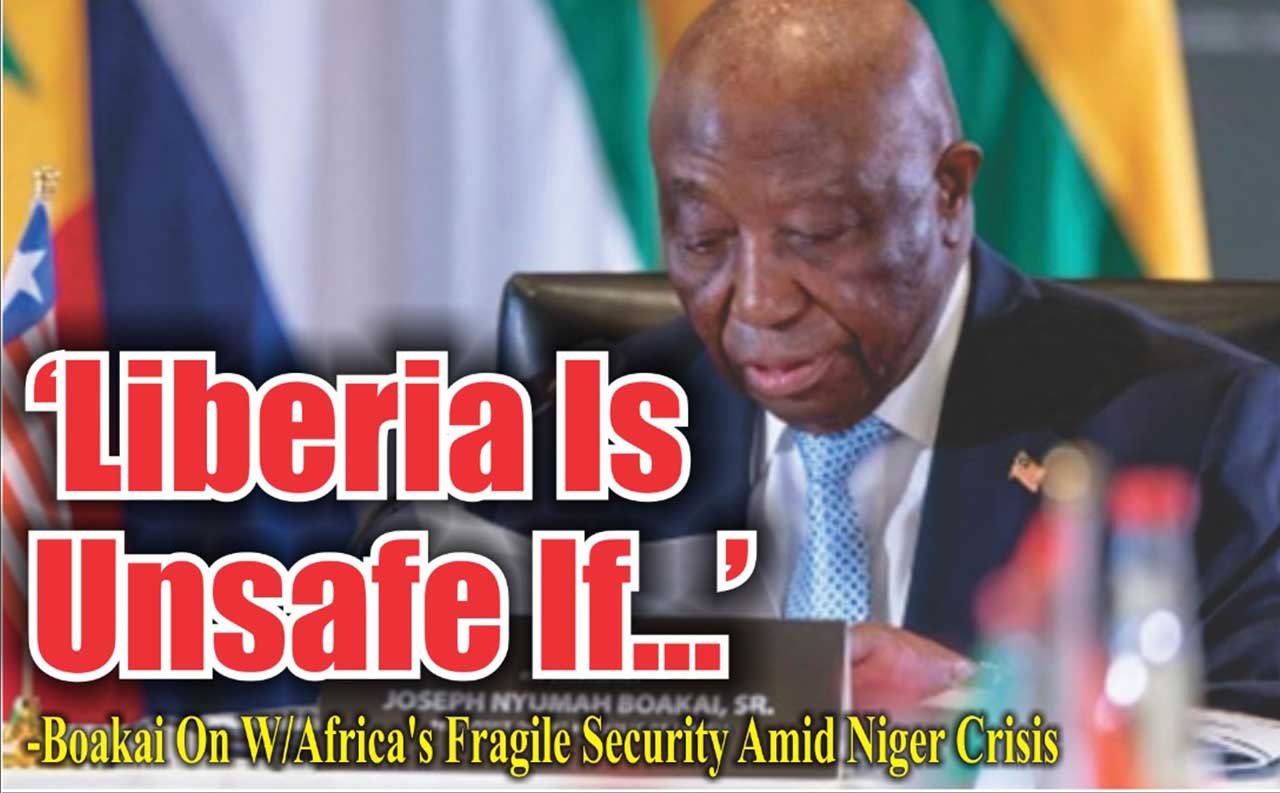
Liberian President Joseph N. Boakai has warned that the latest developments in Niger are a “rude awakening” for West Africa, underscoring the urgent need for collective regional action against rising insecurity, terrorism and transnational crime. Speaking on January 30, 2026, at the High-Level Consultative Conference on Regional Cooperation and Security in Accra, President Boakai said no country in the region can remain safe if its neighbors are destabilized. “Liberia is not safe if an inch of Ghana is in terror,” he mentioned.
The Liberian leader described the situation in Niger as a stark reminder of the realities confronting the sub-region and validated the urgency of the high-level security talks.
However, he extended solidarity to the people of Niger and praised Ghanaian President John Dramani Mahama for convening the conference at what he called a “critical moment” of growing global disorder. Drawing from Liberia’s own history of civil conflict, President Boakai said the country understands the devastating cost of war and instability.
“We lived it; we experienced it, and we continue to bear the scars, the Liberian leader said, while reaffirming Liberia’s commitment to preventing violent conflicts at national, regional and international levels. President Boakai cautioned that once conflicts erupt, they recognize no borders and leave nations destroyed and development stalled.
He outlined a wide range of threats confronting the region, including terrorism, violent extremism, governance deficits, transnational and maritime crime, cybercrime, climate-driven resource conflicts, illicit mining, arms proliferation, human trafficking, illicit financial flows, drug abuse, unemployment, and social injustice. He warned that non-state actors thriving on anarchy and lawlessness are increasingly threatening state authority. At the same time, new security fault lines, especially cybercrime, require urgent attention as borders become “increasingly non-existent.”
Boakai then called for stronger regional solidarity and the embrace of collective security, warning that global polarization and declining cooperation are fueling economic hardship, unemployment, insecurity and poverty, particularly in smaller and vulnerable states. As a non-permanent member of the United Nations Security Council, Boakai said Liberia is prioritizing a regional approach to peacebuilding and security, arguing that international responses should not focus only on crisis epicenters but also involve neighboring countries to dismantle support networks across borders.
He welcomed the outcome document produced by intelligence chiefs, Ministers of Foreign Affairs, and national security officials at the conference, reaffirming Liberia’s readiness to work with other heads of state to implement its recommendations. “We are here because there is only one option: our collective survival. If we fail to act together, we perish together,” Boakai noted. Recently, the Islamic State (IS) claimed an attack on an international airport and airbase in Niger, after motorcycle-riding militants launched strikes using heavy weaponry and drones, damaging planes belonging to Ivorian carrier and Togolese airline, a Guardian news report states.
The attack, which began shortly after midnight on Thursday, reportedly involved motorcycle-riding militants who launched a “surprise and coordinated” strike using heavy weaponry and drones, according to statements released via IS in the Sahel’s propaganda arm, Amaq News Agency. The regional IS affiliate has been linked to high-profile attacks in Niger in recent months, killing more than 120 people in strikes targeting the Tillabéri region in September, and abducting an American pilot in October.
According to the report, the gunfire and explosions in the airport, which is about 6 miles (10km) from the presidential palace and Base Aérienne 101, a military base previously used by US and then Russian troops, hit at least three planes: one belonging to Ivorian carrier Air Côte d’Ivoire and two belonging to the Togolese airline Asky. A source at Asky said the airline staff were in their hotel away from the scene and remained in the city, with their passports still in the custody of the authorities.