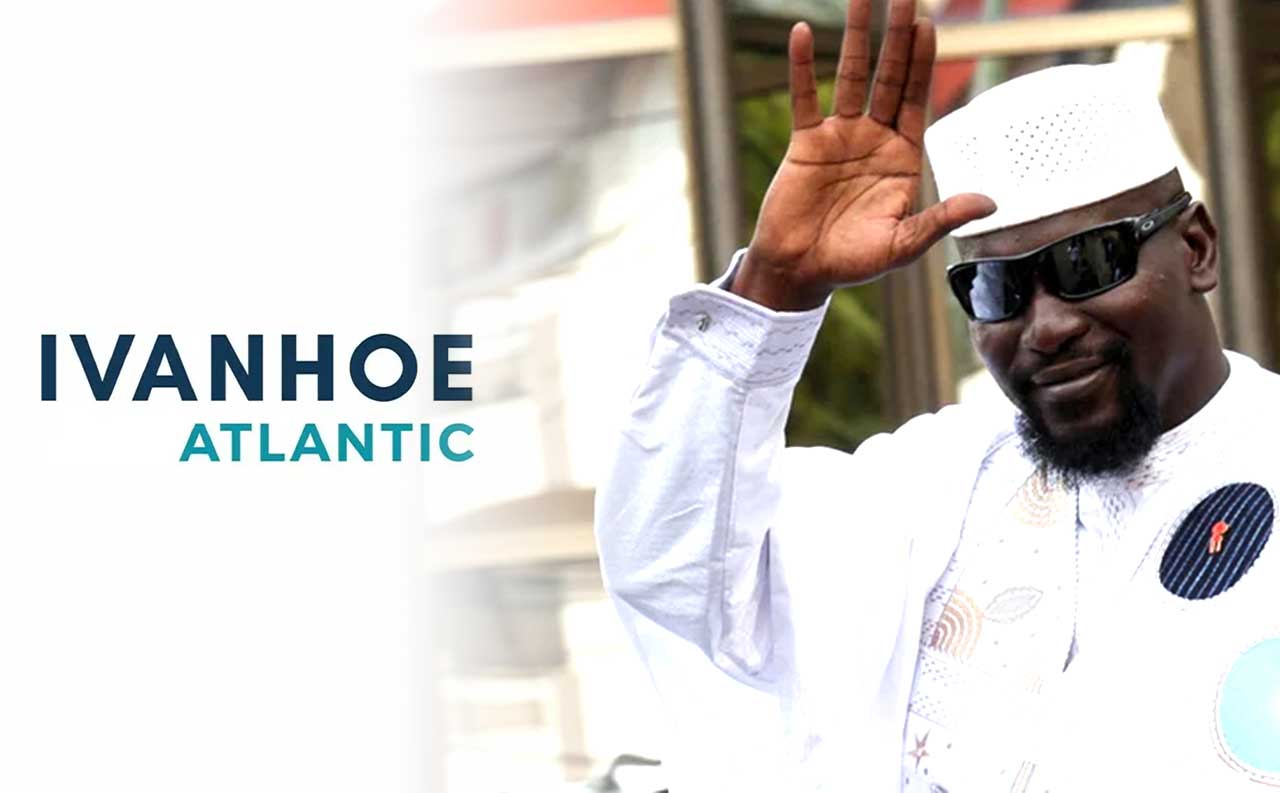
Ivanhoe Atlantic has congratulated Mamady Doumbouya on the certification by the Supreme Court of his election as President of Guinea, assuring continued partnership with the West African nation. A statement quotes Ivanhoe Atlantic as saying it remains committed to a strong and constructive partnership that deepens cooperation between Guinea and the United States. “We look forward to continuing our relationship as a strategic partner to Guinea, demonstrating how U.S. companies can deliver sustainable investment that contributes to realizing Guinea’s national priorities,” Ivanhoe said.
In Liberia, the national Legislature has already ratified the Concession and Access Agreement (CAA) between the Government of Liberia, Société des Mines de Fer de Guinée (SMFG), and Ivanhoe, thus solidifying Ivanhoe’s quest for a multi-user rail system in Liberia. The decision by the House of Representatives and Senate has sent a positive signal that the agreement with Guinea remains on course and will be strengthened under the leadership of the new Guinean President
The passage of the Ivanhoe Atlantic Concession and Access Agreement indicates that Liberia is ready to fulfill the vision of cross-border cooperation enshrined in the 2019 Implementation Agreement between Liberia and Guinea — a treaty that both nations ratified to enable free movement of goods, shared infrastructure, and mutual prosperity.
For the first time in many years, both countries now have full diplomatic representation in each other’s capitals. In October 2025, Liberia’s newly appointed Ambassador to Guinea, Forkpa Gizzie, presented his credentials in Conakry, pledging to deepen bilateral relations and expand trade and economic cooperation between the two countries.
This renewal of diplomacy complements a parallel moment on the Liberian side. In July 2024, Guinea’s Ambassador to Liberia, Aboubacar Sylla, presented his Letters of Credence to President Joseph Nyuma Boakai, Sr., who reaffirmed Liberia’s commitment to strengthening bilateral ties within the Mano River Union (MRU).
The CAA is not merely an investment contract — it is the first real operationalization of the Liberia–Guinea Implementation Agreement ratified by both governments in 2020 and 2021. The bilateral framework, signed in October 2019 and later validated by both nations, was designed to let Guinean mining companies — especially those in the Nimba Mountain range — export their iron ore and other natural resources through Liberia’s Yekepa–Buchanan rail and port corridor. It also guarantees Liberia the right to share in the benefits through infrastructure usage, fees, and expanded trade.
The endorsement of the Ivanhoe Atlantic Agreement reinforces regional integration through shared infrastructure and aligns with Article 1.2 of the treaty, which commits both countries to promoting “the shared use of transport infrastructure to bolster mining development, contribute to sub-regional integration, and strengthen the socio-economic development of both countries.”
Liberia’s approval of the Ivanhoe Agreement is as much a domestic decision as it is a regional signal — to Guinea, to ECOWAS, and to the world — that Liberia is ready to honor its commitments and lead the way in building a multi-user, cross-border infrastructure system that benefits both nations. With the Senate expected to concur this week, Liberia and Guinea stand on the threshold of something their predecessors envisioned more than half a century ago. The first Transit Agreement between the two countries was signed in 1973. The Implementation Agreement of 2019 — and now, the Ivanhoe CAA — represent the next, decisive step toward making that vision real.
The CAA grants SMFG and Ivanhoe Liberia Limited a 25-year right to transport iron ore from Guinea through Liberia using the existing rail line and the Port of Buchanan. Concessionaires are required to upgrade rail capacity and improve the Buchanan Commercial Quay to support safe, multi-user operations. According to the report, Liberia will serve as a transit route for industrial goods destined for Guinea.
Additionally, the agreement provides for a 1.5% customs user fee on imports (CIF-based) and US$500,000 annual customs transit fee for Infrastructure Investments. Ivanhoe Atlantic has already contributed US$37 million to the Liberian Revenue Authority via payments to the Central Bank of Liberia.
In accordance with the CAA, “US$1 million will be paid within 10 business days after it has been signed by the President and published in the gazette. US$10 million within 10 business days after the date the agreement takes effect. US$15 million on the date Ivanhoe Atlantic commences operations on the railway.US$2.33 million on the date the NRA Act is enacted. US$3.33 million on the date the Independent Operator is appointed by the NRA; and US$3.33 million on the first anniversary of the appointment of the Independent Operator.”
The CAA also includes the establishment of a Community Development Fund (CDF) to support communities along the railway in Nimba, Grand Bassa, and Bong. Ivanhoe Atlantic has committed annual payments starting at US$1 million, increasing consecutively to US$5 million annually in five years. This will be contributed annually throughout the decades during which Ivanhoe will transit high-grade iron ore through Liberia. In addition to the concession payments and CDF, Ivanhoe Atlantic will invest nearly US$1 billion in Liberia across two phases, making it one of the largest infrastructure investments in the country’s modern history, focused entirely on road, rail and port systems.
In Phase 1, Ivanhoe Atlantic will invest US$64 million to build roads leading to the railway and rehabilitate the existing track and port infrastructure. Target production capacity once the infrastructure development is completed is 2–5 metric tons per annum (mtpa) of high-grade iron ore. Phase 2 will see an additional US$888 million invested in direct capital costs, split between an estimated US$452 million railway upgrade and US$436 million to expand the Buchanan Port.
The work is projected to expand capacity to accommodate Ivanhoe Atlantic’s target export capacity of 30 mtpa, pending feasibility studies and regulatory approvals. Approximately US $800 million will also be invested in Guinea to connect the countries’ trade corridor.
Moreover, the investment and concession payments granting Ivanhoe Atlantic user-access to the railway will generate approximately US$60 million of revenue per year for Liberia in rail user fees, dividends, taxes, and other sources of revenue generation. In addition to the financial investment, Ivanhoe Liberia will hire 500 people in Phase 1 of the project and create an estimated 3,000 indirect jobs through domestic suppliers and service providers.