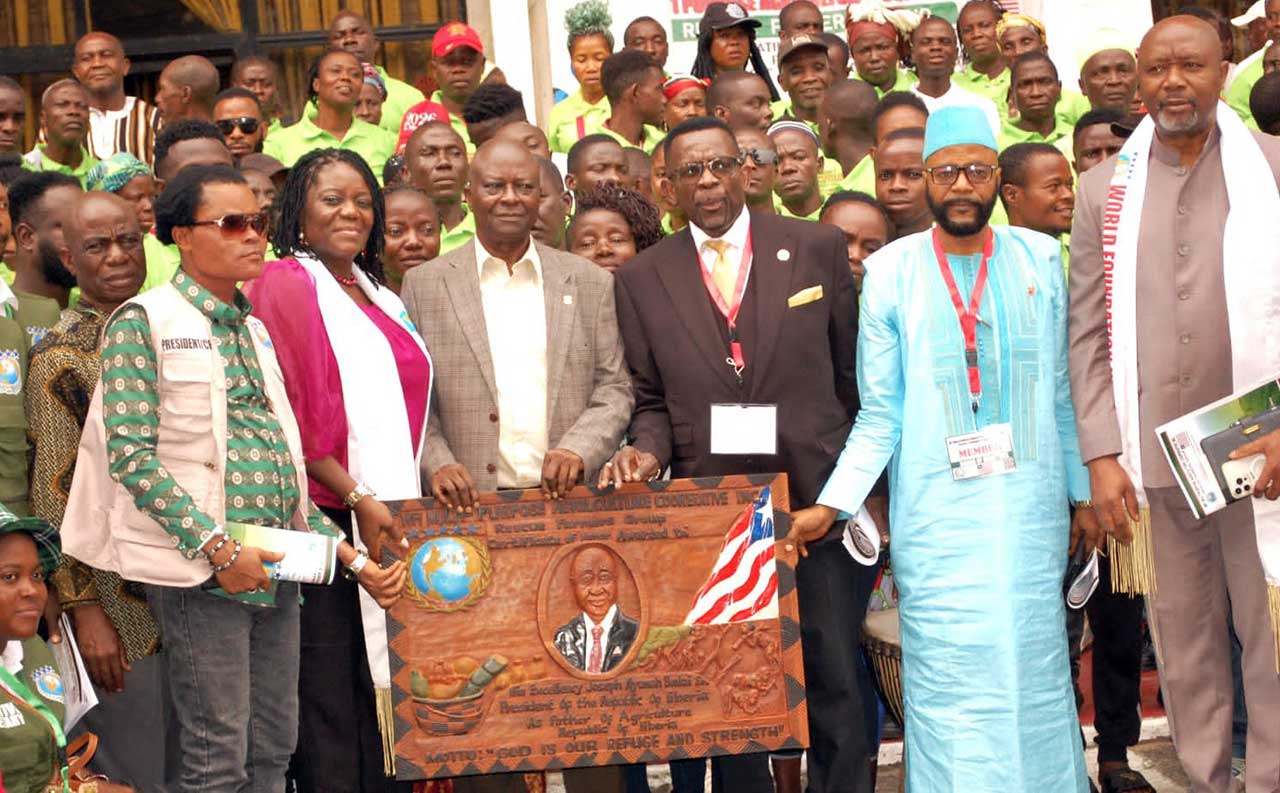
Lincoln Z. Cooper, World Foundation International (WFI) Multipurpose Agriculture Cooperative Inc Chief Executive Officer, has expressed the readiness of Liberian farmers to produce sufficient food to feed the nation, but highlighted weak agriculture logistics. He spoke on Friday, February 6, 2026, when farmers, government officials, youth leaders, and development partners gathered at Monrovia City Hall for the launch of “Operation Feed the Nation.”
The launch, marked by blunt assessments and ambitious pledges, framed agriculture not as subsistence survival but as Liberia’s most strategic economic opportunity at a time of rising food import bills and widespread youth unemployment. He argued that Liberia’s dependence on imported food is not a failure of farmers, but of systems, mechanization, storage, irrigation, farm-to-market roads, and organized cooperatives.
Addressing lawmakers, traditional leaders, youth groups, and international partners, Cooper outlined WFI-MAC’s goal of transforming smallholder farming into a coordinated national enterprise that reduces post-harvest losses and strengthens farmer incomes. “Every bag of rice produced locally saves foreign exchange. Every farmer empowered reduces poverty. Every Liberian community fed with Liberian-grown food strengthens our sovereignty,” he narrated.
Representing President Joseph N. Boakai, Deputy Minister for Public Affairs at the Ministry of State, Anthony V. Kesselly, positioned agriculture at the heart of the administration’s inclusive growth agenda. “Liberians must produce what we eat and eat what we produce. Agricultural cooperatives as critical tools for boosting production, strengthening markets, improving processing, and achieving food security,” he added.
Acknowledging years of hardship faced by farmers, limited inputs, weak infrastructure, and poor market access, Kesselly said the WFI initiative aligns with government priorities to scale up production of rice, cassava, cocoa, and vegetables. For his part, National Investment Commission Chairman Jeff Blibo urged Liberians, particularly young people, to abandon the notion that agriculture is a fallback option.
“Agriculture is not a small business. Agriculture is Liberia’s business,” Blibo explained. He described the sector as a convergence point for land, labor, investment, value chains, and exports, arguing that initiatives like Operation Feed the Nation create the structure and scale investors seek.
“To the young people of Liberia,” he said, “do not see agriculture as a last option. See it as a smart option.” Earlier, Dr. John Wulu, Chairman of WFI’s Board, described the initiative as a commitment to rural dignity, not merely a development program. He disclosed that WFI has begun registering more than 50,000 farmers into a centralized database to connect them to markets, inputs, and financing opportunities.
“Our vision is simple, it is to empower farmers and vulnerable rural populations to live dignified lives through self-sufficiency and economic independence,” WFI’s Chairman stated. He acknowledged persistent rural challenges, limited healthcare, clean water, housing, and extension services, and said the cooperative model is designed to address these gaps collectively. “This cooperative belongs to the farmers. Its success depends on unity, transparency, and discipline,” he said.