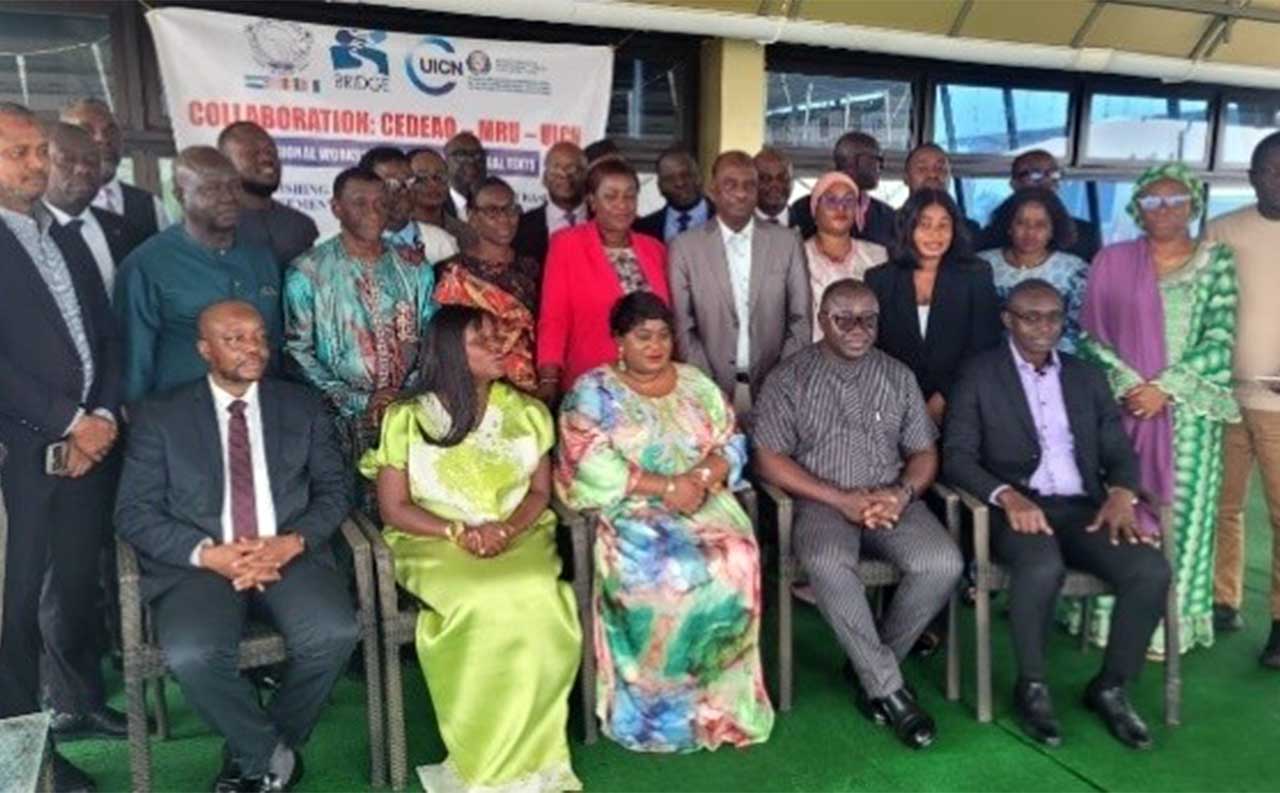
West Africa’s push for stronger regional water governance reached a critical milestone on Tuesday, December 16, 2025, as the Economic Community of West African States (ECOWAS), the Mano River Union (MRU) and the International Union for Conservation of Nature (IUCN) convened a high-level regional workshop in Monrovia.
The gathering is intended to validate the legal framework for managing shared river basins across the MRU sub-region. The three-day workshop, December 16 to 18, 2025, brings together policymakers, lawmakers, water experts and development partners from Liberia, Sierra Leone, Guinea and Côte d’Ivoire to finalize and endorse the draft legal texts establishing the Trans boundary Water Basins Management Office.
The initiative marks a decisive step toward coordinated management of Trans-boundary Rivers in a region where shared water resources are increasingly under pressure from climate change, population growth and competing development needs.
The proposed TWBMO–MRU is anchored in regional agreements dating back to the 1998 Ouagadougou Declaration, which called for stronger consultation frameworks among countries sharing river basins. Since then, ECOWAS has adopted key policies and action plans, culminating in a 2008 decision to promote new trans-boundary basin organizations across West Africa.
Following feasibility studies and consultations in Abidjan and Conakry between 2018 and 2019, experts drafted constitutive and organic texts, alongside an administrative and financial procedures manual and an operationalization plan for the new body. These documents have since undergone national-level reviews in all four MRU member states.
Speaking at the opening, MRU Deputy Secretary General for Economic Development and Regional Integration, Ama Gborie Foday, underscored that the workshop goes beyond the validation of documents, including the protocol, organic text, procedures manual, and operationalization plan.
She said it reflects a shared regional ambition to prevent water-related conflicts and transform shared rivers into instruments of cooperation, development and peace. “Water knows no borders,” warning that without strong legal and institutional mechanisms, shared water resources could become sources of tension rather than engines of unity,” Madam Foday stated.
She emphasized that the decisions taken at the workshop would shape transboundary water governance in the Mano River basin for generations to come. Opening the workshop on behalf of the Liberian government, Wynitta K. Gwaikolo, Director, Liberia Hydrological Service at the Ministry of Mines and Energy, said the establishment of the Trans-boundary Water Basin Management Office marks a critical milestone in regional integration and sustainable development.
“This initiative is vital for our collective future. As population growth and climate change intensify pressure on shared water resources, failure to manage them properly could turn cooperation into conflict. This office gives us a framework to manage these resources peacefully and sustainably for current and future generations,” she narrated.
For his part, Dr. Nathaniel B. Walker, Political Advisor office of the Resident Representative of ECOWAS in Liberia, hailed the gathering as a “crucial junction for regional cooperation and sustainable development,” reaffirming ECOWAS’ commitment to regional integration through shared natural resource management. Walker praised the Liberian government for hosting the event and noted that the turnout of delegates signals the high priority countries attach to collective water governance.