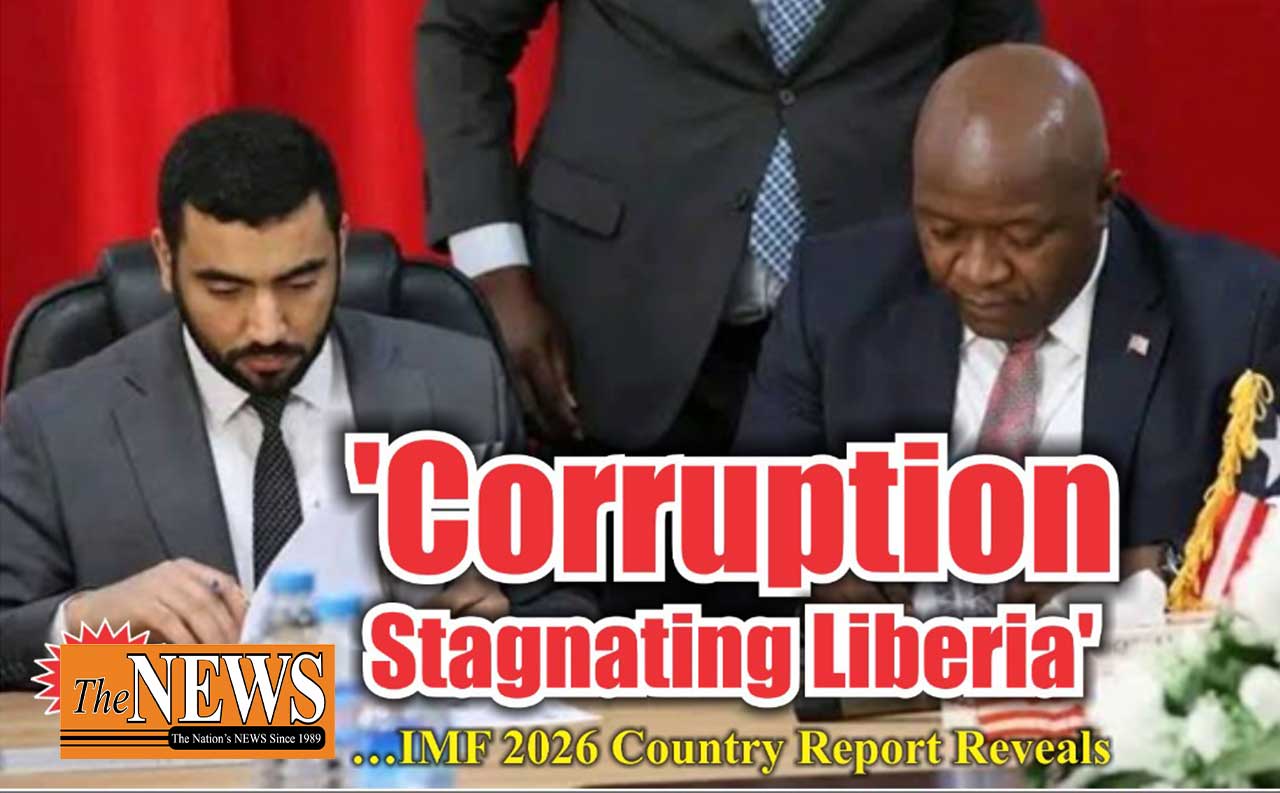
The International Monetary Fund has approved a fresh US$50 million for Liberia, but its newly released country report delivers a blunt warning: the economy is growing, yet the reform agenda is falling far behind, and systemic corruption, compounded by an underfunded anti-corruption commission, is holding the country back.
The IMF Executive Board completed the fourth review of Liberia’s Extended Credit Facility (ECF) and the first review of its Resilience and Sustainability Facility (RSF) on September 28, 2026, unlocking SDR 19.3 million (about US$26.2 million) and SDR 17.62 million (about US$23.96 million), respectively. The staff report was completed on September 9, 2026, following discussions that ended June 23, 2026, and was released as part of the package accompanying the board’s September 28 decision.
The report says systemic corruption and weak rule of law remain macro-critical problems for Liberia, contributing to institutional weaknesses and constraining fiscal capacity, the investment climate, and inclusive growth. It identifies weaknesses in public financial management, limited transparency, and gaps in oversight institutions.
The IMF’s board statement was explicit on the issue. Acting Chair Bo Li said publishing the governance diagnostic report and implementing a focused action plan “would signal to development partners the authorities’ firm commitment to addressing institutional weaknesses and combating corruption.” He also urged Liberia to remove legal barriers preventing the publication of all public officials’ asset declarations-a pointed critique of the country’s transparency regime.
Most starkly, the IMF report states that asset-declaration compliance declined by 19 percentage points from the previous year, a significant deterioration in a key accountability mechanism intended to expose conflicts of interest and unexplained wealth among public officials. Publication of asset declarations currently requires court authorization; legislation to remove that requirement has been submitted to the Legislature but remains unapproved.
The report also flags that recent audits identified discrepancies between revenues recorded in the Tax Administration System and amounts actually credited to consolidated revenue accounts, a serious public-finance concern and calls for publication of outstanding special audit reports, including the audit of historical domestic debt covering 1980–2024 and the NASSCORP audit.
While budget allocations to integrity institutions increased in FY2026, the IMF explicitly states that the Liberia Anti-Corruption Commission (LACC) remains constrained by limited resources. The report calls for the LACC to be “fully operationalized, adequately funded and equipped to enforce accountability.” An anti-corruption institution cannot be effective merely by existing in law, the Fund notes; it needs the resources and institutional capacity to investigate, verify and enforce. It urges stronger verification and enforcement mechanisms and prompt passage of the proposed asset-declaration amendments.
Program performance, while described as “broadly satisfactory,” fell short on several fronts. Two of five indicative targets for December 2025 were missed: one on the Liberian dollar share of public sector wage payments and another on the accumulation of new domestic arrears.
While the IMF attributed the arrears miss to a technical delay at the Central Bank of Liberia, it noted the Liberian dollar wage target failure came despite an overall increase in the local currency share of total expenditure.
Structural reform implementation was weaker still. According to the report, “all six applicable structural benchmarks missed their original deadlines.” Only three were implemented with delay, one was completed as a prior action, and the remaining two revenue code amendments to support VAT implementation and publication of the Governance Diagnostic report with a time-bound action plan required deadline extensions to October and November 2026.
The report notes that implementation of recommendations from the General Auditing Commission’s compliance audit and the Kroll forensic audit has progressed “more slowly than envisaged.” While the Central Bank of Liberia has begun reconciling suspense accounts and strengthening oversight of financial guarantees, the IMF says remaining safeguards recommendations must be accelerated, including reforms to bring the CBL’s governance and internal-control framework fully into conformity with the CBL Act.
The report highlighted continuing weaknesses in the financial sector. The banking system’s non-performing loan (NPL) ratio declined from 19.6 percent at end-2024 to 13 percent in March 2026, but the improvement was largely attributable to loan write-offs rather than borrowers repaying their loans. Of the US$42.3 million reduction in the NPL stock since 2024, approximately US$39.7 million came from write-offs. More recent data show the NPL ratio rising again to 16.6 percent in May 2026, with the state-owned bank recording an NPL ratio of 33 percent in March 2026.
The IMF noted that recapitalization of weak banks is “progressing, though more slowly than planned,” and called for “accelerating the reduction of non-performing loans” to strengthen bank balance sheets and support private sector credit growth. Issuing new banknotes was described as an “immediate priority to alleviate current shortages.”
The report warned that Liberia’s external position remains fragile. The current account deficit is projected to widen to 18 percent of GDP in 2026—up sharply from earlier projections driven by dependence on imported fuel, capital goods, and specialized services. While a one-off US$200 million mining concession payment from ArcelorMittal Liberia in March and increased World Bank budget support have provided temporary relief, the IMF cautioned that the authorities must manage the windfall “prudently and transparently,” phasing its use over 2026–27 given “implementation capacity constraints.”
The fund also flagged that declining donor support and elevated global fuel prices are weighing on the economy, and noted that “reduced donor support or tighter global financing conditions would weaken financing prospects.”
The IMF urged Liberia to “rationalize unproductive expenditures” to create fiscal space for priority infrastructure projects, while “preserving fiscal discipline.” It stressed that “enhancing selection, implementation, and monitoring of capital projects will be essential to raising the quality of public spending.” The report further cautioned that “delays in implementing key reforms could exacerbate existing vulnerabilities,” and that “capacity constraints could delay key reforms and the realization of expected benefits.”
Liberia remains “highly vulnerable to climate-related shocks, including floods and extreme weather events, which could disrupt agricultural production, undermine food security, and generate significant fiscal costs,” the report stated. It also noted that “inadequate infrastructure may hamper economic diversification and prolong reliance on extractive industries,” with gold accounting for about 65 percent of goods exports a concentration the fund described as a risk. (Source: IMF 2026 Country Report)