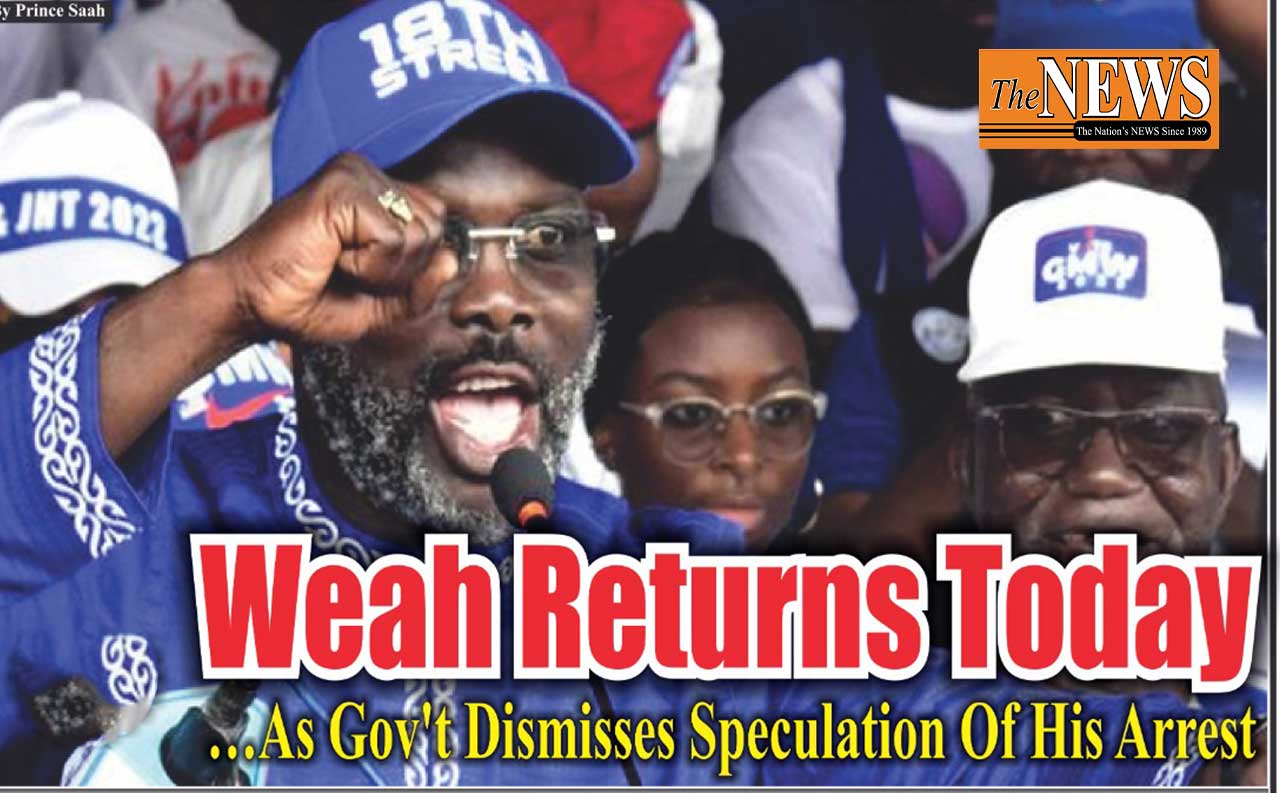
Liberia’s main opposition leader and former President of Liberia George Manneh Weah is expected to return to Liberia today Wednesday, September 2, 2026, with an aggressive political agenda previously rallying Liberians against the Boakai-Koung administration and begin positioning himself for a return to the presidency in 2029.
Weah, who governed Liberia from 2018 to 2024, is expected to arrive through the Roberts International Airport (RIA) following visits to the United States of America and other countries, returning home with his political intentions clearly declared.
While in the United States, the former President held a retreat with members and supporters of his Congress for Democratic Change (CDC), where he declared his intention to contest the 2029 presidential election.
Weah also said that upon his return to Liberia, he would rally Liberians against the government of President Joseph N. Boakai and Vice President Jeremiah Kpan Koung, signaling a potentially more confrontational phase of opposition politics.
The pronouncement places the former President on a direct political collision course with the Boakai-Koung administration and could mark the beginning of an early mobilization campaign more than two years before Liberians officially head to the polls.
Weah’s expected arrival today is therefore shaping up to be more than a routine homecoming. He returns as a declared presidential contender who has openly promised to mobilize citizens against the administration that replaced him in January 2024.
His return could also energize the CDC’s political base, which has remained one of the strongest opposition blocs since the party lost state power following the tightly contested 2023 presidential runoff election.
However, Weah lost that election to Joseph Boakai by a narrow margin and conceded defeat, paving the way for Liberia’s second peaceful democratic transfer of presidential power in decades.
But nearly three years after leaving the Executive Mansion, the former President has made clear that his defeat did not mark the end of his presidential ambitions. His declaration in the United States removes much of the uncertainty surrounding his political future and potentially forces other opposition politicians considering the presidency in 2029 to reassess their calculations.
Upon his return, the former president’s pledge to rally Liberians against the Boakai-Koung administration could also intensify scrutiny of the government’s performance as the CDC seeks to capitalize on public concerns over governance, economic conditions and other national issues.
It remains to be seen what form Weah’s promised mobilization will take, what specific grievances he intends to campaign around, and how quickly the CDC will translate his declaration into organized political activities across Liberia.
For the ruling administration, Weah’s return means confronting an opposition leader who remains nationally recognizable and commands a substantial political following despite losing the presidency.
The former football superstar remains the dominant personality within the CDC and one of Liberia’s most influential political figures, particularly among grassroots supporters and young people who have formed an important part of his political base.
Before entering politics, Weah built a celebrated international football career, becoming the first African to win the Ballon d’Or before eventually turning his enormous popularity into political power.
He won the 2017 presidential election and served a six-year term, but his administration faced criticism over economic hardship, governance and allegations of corruption. Weah and his supporters have consistently defended his record, highlighting infrastructure and development projects undertaken during his presidency.
Now seeking another opportunity to govern, Weah will face the challenge of defending that record while convincing Liberians that the current administration should be replaced and that he deserves another mandate.
His promised campaign against the Boakai-Koung government could therefore become an early test of whether the political support that carried him to the presidency in 2017 remains strong enough to propel another national movement. It could equally test the Boakai administration’s ability to defend its record as it confronts increasingly organized opposition ahead of the 2029 political season.
Attention will now shift to Roberts International Airport and what follows Weah’s arrival, including whether the former President immediately begins the nationwide political mobilization he promised while abroad.
For Weah and the CDC, Wednesday’s homecoming could mark the opening shot of a long road toward 2029. For the Boakai-Koung administration, the man it defeated in 2023 is returning home with a clear message: he wants the presidency back, and he intends to rally Liberians in pursuit of it.
Meanwhile, Information Minister Jerolinmek M. Piah has dismissed speculation that the government is planning to arrest former President George Manneh Weah upon his return to Liberia, describing the reports as unfounded.
Piah’s denial follows concerns raised within the opposition Congress for Democratic Change (CDC) over the possibility of Weah’s arrest amid heightened political tensions and the detention of former Vice President Jewel Howard-Taylor.
Speaking on a local radio station Monday, Piah said the government has no plan to arrest the former President, rejecting reports circulating among CDC supporters. Speculation about Weah’s possible arrest intensified Sunday, August 30, at the CDC’s temporary headquarters in Sinkor after former Finance Minister Samuel D. Tweah Jr. urged supporters to turn out in large numbers to welcome Weah at Roberts International Airport on Wednesday, September 2. Tweah said the call for a massive turnout was not intended merely as a demonstration of the CDC’s political strength, but was prompted by what he described as a worsening political climate in the country.
“We have welcomed him with a massive crowd before, but the circumstances then were different,” Tweah said. “The former vice president of the country is in jail illegally. Wednesday is the biggest day in Liberia’s history.” He said Weah’s return would mark the beginning of a renewed political push by the opposition to confront what he characterized as challenges to democracy and the rule of law. “We will be trooping here as he comes to face the challenges that we are now facing,” Tweah said.
The former Finance Minister also criticized the government’s prosecution of former Vice President Howard-Taylor, arguing that the charges against her are politically motivated. Tweah said governments have enormous powers to investigate and prosecute alleged crimes, but warned that such authority should not be used to manufacture charges against political opponents.
“Governments all over the world have the advantage in prosecuting and charging people, but the government should not invent a charge because it is the government,” he said. He maintained that Howard-Taylor is innocent of the charges against her and accused the administration of undermining confidence in the country’s justice system.
The government has denied allegations of politically motivated prosecutions and has maintained that ongoing criminal cases should be allowed to proceed through the courts.
At the same time, Tweah used the occasion to defend the former CDC administration’s economic and governance record, claiming that it performed better than the current Unity Party government in economic management, investment, accountability and the rule of law. He cited Liberia’s international reserves and economic growth figures to support his argument. “We inherited a reserve of one hundred and ten million from the UP government. We handed this government a reserve of two hundred and twenty million,” Tweah said. He claimed that Liberia’s net international reserves currently stand at about US$250 million, arguing that the increase under the current administration has been relatively modest.
Tweah also asserted that the CDC administration left office with economic growth at about 4.8 percent, compared with what he described as significantly lower growth when the party assumed power in 2018.