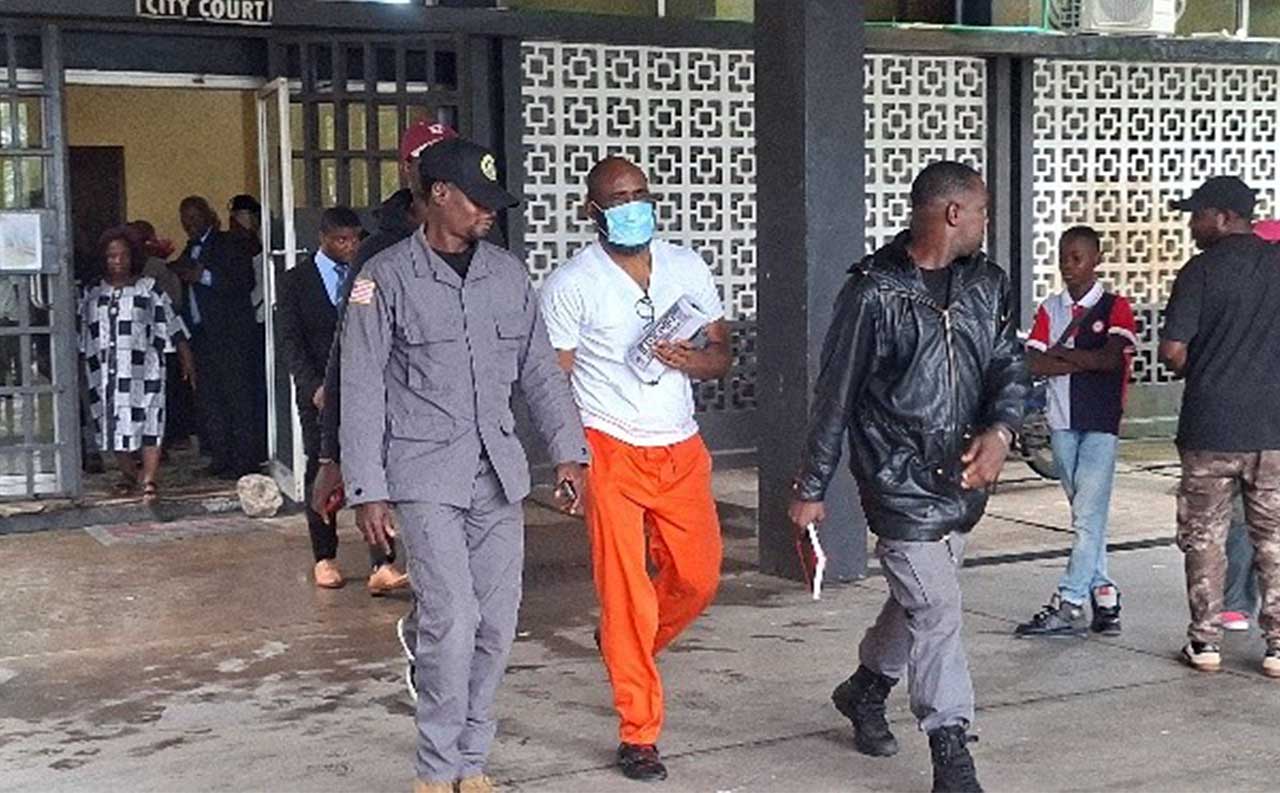
Monrovia City Court Magistrate L. Ben Barco has ruled that prosecutors established probable cause against Paul Jamaal King and several co-defendants in the alleged US$19.2 million cocaine trafficking case, ordering that the matter be forwarded to Criminal Court “C” for trial after an indictment is drawn by Criminal Court “A”.
The ruling, delivered on Wednesday, July 15, 2026, followed the conclusion of the preliminary examination, during which Magistrate Barco considered whether the prosecution had presented sufficient evidence to justify a full criminal trial.
Magistrate Barco, in his decision, held that the prosecution met the legal threshold required under Liberia’s Criminal Procedure Law. “The evidence demonstrates a coordinated scheme to traffic narcotics valued at US$19 million through Liberia’s airport system,” the magistrate ruled, ordering that King and his associates be bound over for trial on charges brought under the Penal Law of Liberia and the Drug Law of 2023.
The court directed the Clerk of Court to transmit the case to Criminal Court “C” for further proceedings, after which time the Special Grand Jury indicts King and others for Montserrado County. Immediately following the ruling, one of King’s lawyers, Cllr. James N. Kumeh, formally took exception to the decision and announced that the defense would pursue the legal remedies available under Liberian law.
Addressing the legal arguments raised during final submissions on July 13, Magistrate Barco rejected the defense’s reliance on historical United States cases, including Aaron Burr v. United States and Plessy v. Ferguson, describing them as inapplicable to the issue before the court.
Magistrate Barco noted that while those decisions addressed constitutional and civil rights issues within the United States, they carry limited persuasive authority in Liberia and do not govern preliminary examinations involving probable cause.
He emphasized that at the preliminary hearing stage, the prosecution is not required to prove guilt beyond a reasonable doubt, but only to establish sufficient evidence that a crime may have been committed and that the accused may have committed it.
Relying on Chapter 12 of Liberia’s Criminal Procedure Law and the Supreme Court’s decision in Wolo v. Republic of Liberia (33 LLR 3, 1986), the court reiterated that probable cause is a relatively low legal threshold intended to prevent arbitrary prosecution while allowing legitimate criminal cases to proceed to trial.
The prosecution’s case was built primarily on the testimony of LDEA Chief Investigator Colonel Moses L. Meah and Liberia National Police Anti-Narcotics Unit Commander Superintendent Joseph M. Kaiffa.
According to the prosecution, King orchestrated the shipment of six boxes falsely declared as containing Maggi seasoning cubes and lappas, which investigators later discovered concealed 237.6 kilograms of cocaine with an estimated street value exceeding US$19.2 million. Colonel Meah testified that King allegedly coordinated the shipment using false airway bills and fictitious companies while attempting to disguise the narcotics as ordinary commercial goods.
The prosecution further presented documentary and physical evidence, including the police charge sheet, airway bills, shipping receipts, photographs of the seized cargo, and samples of the suspected cocaine.
Superintendent Kaiffa corroborated Meah’s testimony, telling the court that investigators traced the shipment to King’s residence and that airport security officers became suspicious after discovering discrepancies between the declared and actual weight of the cargo during screening at Roberts International Airport.
According to the prosecution, investigators also uncovered evidence suggesting attempts to retrieve the shipment after the narcotics had been discovered. Throughout the proceedings, the defense maintained that King was innocent of the charges.
Defense lawyers challenged the credibility of the investigation, questioned the handling of evidence, raised procedural objections, and pointed to alleged inconsistencies regarding the status of another suspect, Michael U.S. Brown. The defense argued that the prosecution failed to establish a direct link between King and the narcotics and urged the court to dismiss the charges for lack of probable cause.
They further relied on historical U.S. legal authorities to support their arguments, but the court concluded that those precedents did not govern Liberia’s standards for determining probable cause. Magistrate Barco, analyzing the evidence, found that both prosecution witnesses consistently linked King to the shipment through witnesses’ testimonies and documentary evidence.
The court concluded that the seizure of the cocaine at Roberts International Airport, together with the airway bills, receipts, photographs, and witness statements, established reasonable grounds to believe that the defendants participated in the alleged trafficking operation.
The magistrate ruled that the prosecution had presented sufficient evidence to support charges of Unlicensed Exportation of Controlled Drugs and Substances, Unlicensed Sale, Trading, Transit and Transportation of Controlled Substances, Unlicensed Possession and Sale of Controlled Drugs, Illegal Drug Trafficking, Criminal Conspiracy, Criminal Facilitation, and Criminal Solicitation.
The case stems from a joint investigation conducted by the Ministry of Justice, the Liberia Drug Enforcement Agency (LDEA), the Liberia National Police, and other security agencies following the interception of six suspicious boxes at Roberts International Airport between June 5 and June 7, 2026. Investigators alleged that the shipment, destined for England, contained 237.6 kilograms of cocaine concealed inside packages labeled as commercial goods.
The defendants named in the police charge sheet include Paul J. King, Michael U.S. Brown, also known as Rahim Bah and Polo Bah, Usman Ali, Oscar Brown, Emmanuel Kpeh, and others yet to be identified.
With the preliminary hearing now concluded, the case moves to Criminal Court “A” for indictment and will later be forwarded to Criminal Court “C” during the August term of court, where prosecutors will be required to prove the allegations beyond a reasonable doubt during a full criminal trial.