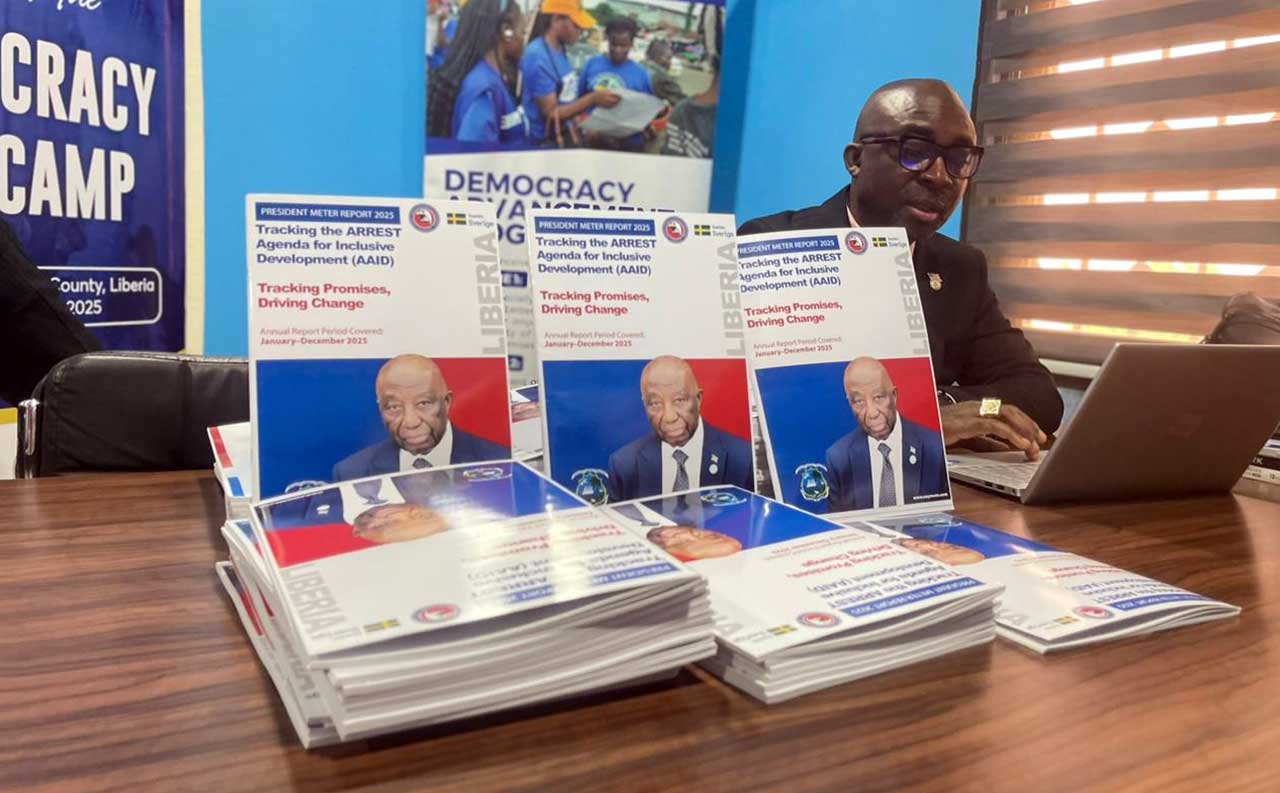
Ahead of President Boakai’s State of the Nation address, Naymote Partners for Democratic Development has released the President Meter Report 2025, suggesting low progress in projects meant for development purposes. Speaking in Monrovia on Tuesday, January 13, 2025, the Executive Director of Naymote, Eddie Jarwolo, said the report tracks 378 interventions across 52 core programs and 6 strategic pillars, offering a comprehensive snapshot of progress, gaps, and systemic challenges in delivering Liberia’s national development blueprint launched by President Joseph Boakai on January 15, 2025.
According to him, the findings show that only three interventions were fully completed, constituting 0.8 percent. These interventions include the passage of the National Tourism Authority, 17,000 cubic meter gasoline tanks, a modern petroleum testing laboratory, and the national action plans on business and human rights within one year. While 165 interventions, which constitute 43.7 percent, show some level of progress, 76 interventions, 20.1%, have not started, and 134 interventions, 35%, couldn’t be rated due to unavailable implementation data. The report states that 93 projects were completed in one year; this current pace suggests that if the government doesn’t speed up, its target will be missed, failing to achieve its development agenda by the year 2029.
The report further revealed that a road rehabilitation and groundbreaking ceremony for 63 communities across Montserrado, Margibi, and Bomi, covering 103 KM of roads with 238 culverts, took place on March 20, 2025. Phase one covers 28 communities, 18 roads, 42 KM with 100 culverts.
The Caldwell road rehabilitation contract was signed on June 10, 2025, with work in progress; the Urban Resilience Project was launched for the Paynesville-Boulevard, Police Academy and Sinkor belt, but these projects are being stalled because of challenges facing the Ministry of Public Works, including understaffing, weak project management systems, limited technical resources expertise and inadequate equipment and machinery have led to road maintenance neglect. Roads are deteriorating due to insufficient maintenance, systematic asset management, and chronic underfunding.
Jarwolo emphasized that a total of 44.5% of interventions have seen at least some action, while 55.5% of the AAID remain either not started or not rated. These findings underscore the urgent need to enhance monitoring, reporting, and accountability to ensure that the strategic objectives of the AAID are realized.