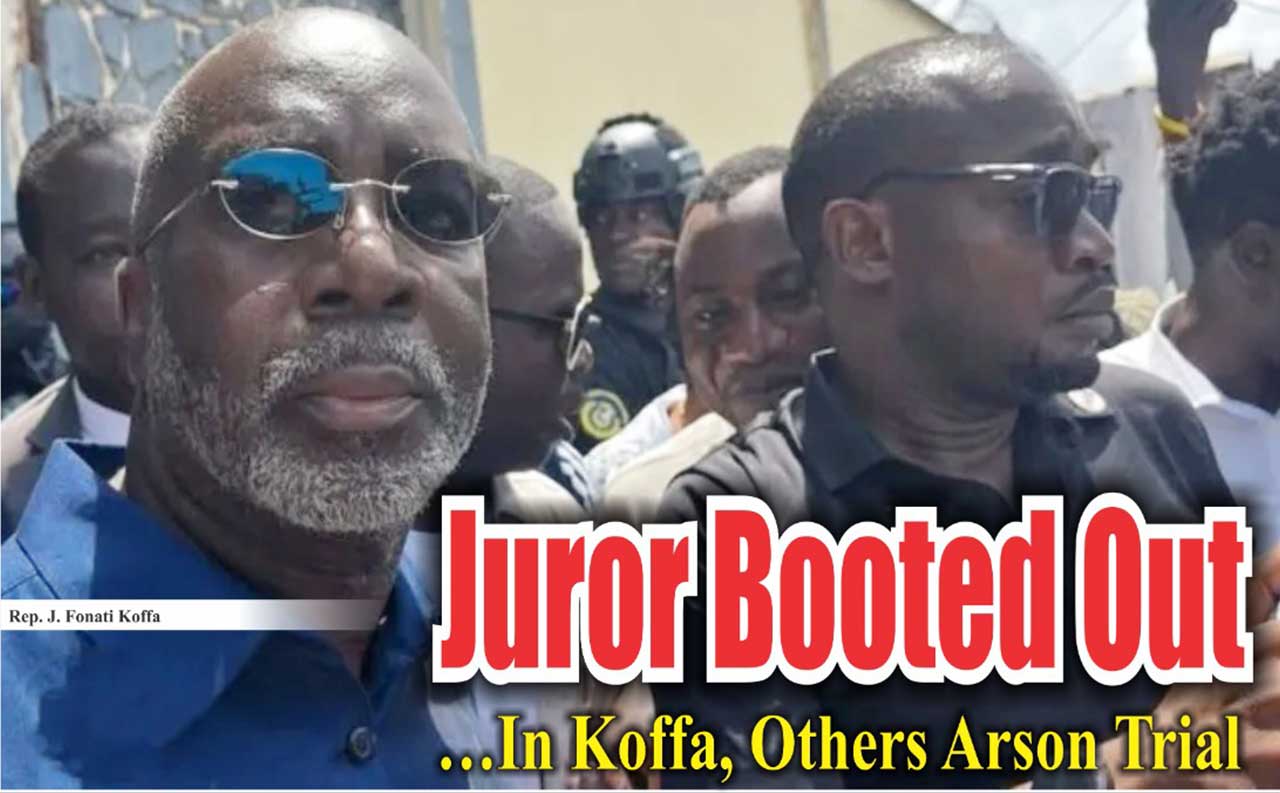
A day after state prosecutors in the Capitol arson case involving former Speaker J. Fonati Koffa and other lawmakers filed a motion to remove one of the jurors from the panel due to her political affiliation connections, the court has finally removed Juror Antoinette Mulbah. Prosecutors had filed a six-count petition to Criminal Court ‘A” Judge Roosevelt Z. Willie based on her alleged connections with stalwarts of the Congress for Democratic Change (CDC) in the ongoing arson case.
During the Tuesday, December 2, 2025, heated legal arguments before the court, Judge Willie ordered the removal of juror Mulbah, assigned number J30-9550, due to an allegation that she’s a CDCIAN, which suggests bias. The Judge’s decision to remove the juror sparked strong objections from the defense counsels, who accused the prosecution of deliberately attempting to stall proceedings and undermine the integrity of the jury.
On Monday, December 1, 2025, state prosecutors filed a six-count motion alleging that juror Mulbah is an affiliate of the Congress for Democratic Change (CDC), which could compromise her impartiality. Prosecution argues that they are not objecting to Juror Antoinette Mulbah’s political affiliation with the CDC, acknowledging it’s her constitutional right. Instead, they’re challenging her statement during the selection process, claiming she misrepresented herself by saying she had no connection to the defendants, who are CDC stalwarts, and termed this alleged misinformation as the basis for their objection, aiming to ensure the trial’s integrity.
Rebutting the prosecution’s request for juror Mulbah’s removal, the defense team argued that the repeated filings of motions by the state were part of a strategy aimed at delaying the trial and ultimately disbanding the jury panel. According to Koffa’s team of lawyers, the prosecution’s actions violate the 1986 Constitution of Liberia, which prohibits discrimination against citizens based on political association.
Defense lawyers argued that no Liberian citizen should be prevented from performing civic duties, including jury service, because of their membership in a political party. The lawyers contended that state prosecutors had both the opportunity and legal means to challenge the juror during voir dire, including the use of peremptory challenges, noting that government lawyers had failed to do so at that time, and insisted that the prosecution had effectively forfeited any later objection.
The defense counsels said central to the prosecution’s claim was an allegation that the juror in question, identified as Juror J30-9550, is a member of the Congress for Democratic Change (CDC) and serves as Chairperson of District #13. Photos purportedly showing the juror participating in partisan activities were attached to the motion filed by the prosecution team.
However, Defense Counsel dismissed the images as “not scientific or virtual proof,” arguing that they failed to meet the evidentiary standard required to justify the juror’s removal. The Defense further noted that the court had previously denied a similar Prosecution motion seeking the removal of another juror, Juror 130-9819, also based on alleged political affiliation and a photo submitted as evidence.
That precedent, they argued, should guide the court to reject the Prosecution’s attempt to eject a juror on constitutional grounds. Additionally, the defendants’ lawyers invoked Article 17 of the Liberian Constitution, which guarantees the right of citizens to associate freely, including the right to membership in political parties.
The lawyers maintained that removing a juror solely for political affiliation amounts to a violation of those constitutional protections. Despite these arguments, Judge Willie moved to excuse the juror, a decision that is expected to generate further legal debate as proceedings continue. The defense team asserted that the removal of juror J30-9550 highlights broader concerns over political influence, impartiality, and constitutional rights within the judicial process.
The matter has now added another layer of tension to an already closely watched trial, with both sides signaling readiness to challenge any attempt seen as undermining fairness or due process. Liberia’s legal framework is clear that mere political affiliation isn’t enough to disqualify someone from jury service; as such, there must be evidence of actual bias or a reasonable apprehension of bias.
It can be recalled that Judge Roosevelt Z. Willie had denied a similar request for the removal of Juror Antoinette Mulbah on the basis that the prosecution failed to establish evidence of actual bias, and the court cannot rely on unauthenticated photographs from social media. The Liberian Constitution and jury law, according to Willie, prioritize impartiality, and the court will only remove a juror if there’s proven bias or conflict of interest.In this case, juror Antoinette Mulbah denied being in the images of a group of partisans of the CDC during a campaign rally, explaining that the individual identified by the prosecution was her mother
Willie’s ruling aligns with this principle, denying the prosecution’s request to remove Juror Antoinette Mulbah solely because of her affiliation with the CDC.
The prosecution furthermore argued by claiming Juror Antoinette Mulbah’s alleged false answer about her connection to the defendants shows she can’t be impartial.
They’re pointing to a photo they believe is her receiving birthday wishes as a party chairperson/coordinator, suggesting she’s more involved with the CDC than she let on. This, they argue, means she likely interacts with the co-defendants, compromising her ability to remain unbiased.
Meanwhile, the matter is expected to go into full trial on Wednesday, December 3, 2025, at 10 a.m. in the Chambers of Criminal Court ‘A’ at the grounds of the Temple of Justice. However, Defense lawyers expressed grave concern, describing the ruling as “unprecedented, unconstitutional, and dangerous for the integrity of jury trials in Liberia.”
Several defendants in the case remain incarcerated without bond, and the continued destabilization of the jury selection process risks further delaying an already prolonged trial. The case of former Speaker J. Fonati Koffa and several other defendants, including three sitting lawmakers, was unexpectedly suspended on Monday, December 1, due to concerns over a juror’s potential bias.