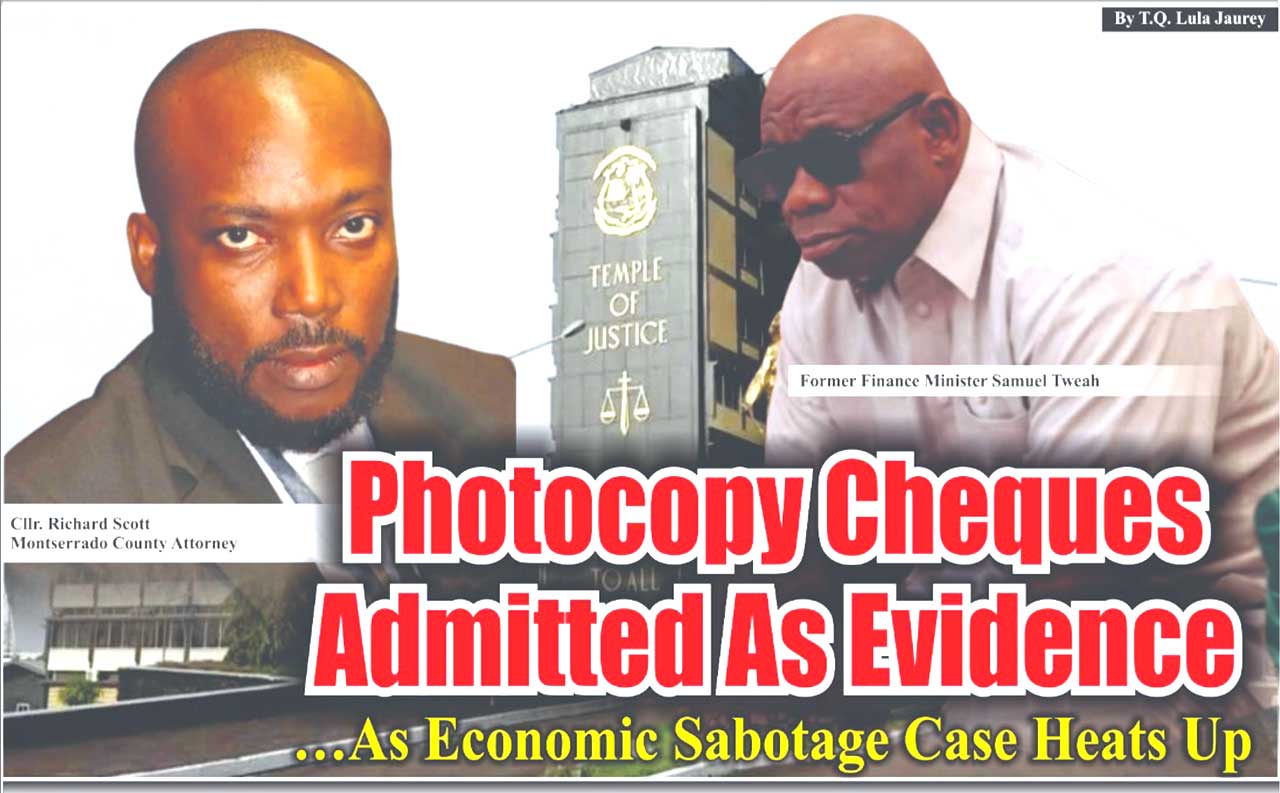
Prosecution and Defense lawyers in the case involving former Finance Minister Samuel Tweah and other ex-officials of government engaged in heated arguments on Monday, March 30, 2026, after the state secured a significant victory in getting several crucial pieces of evidence admitted into the trial.
Prosecutors presented a series of documents deemed essential to proving the alleged financial misconduct, including the official ledger, transaction tickets, and copies of the checks signed by former Comptroller General Moses Cooper of the Financial Intelligence Agency (FIA).
Records from the Central Bank of Liberia (CBL) confirmed that the bank received all the signed documents during the transactions in question. Lead Prosecutor, Cllr. Richard Scott, argued on evidentiary standards, emphasizing that most of the documents tendered were originals, except the checks presented in copied form, which he insisted were admissible under Liberian law.
Cllr. Scott cited Chapter 25, Section 25.6 of the Criminal Procedure Law (Title 2, Liberian Code of Laws Revised), which establishes the Best Evidence Rule.
The law states: “When the original document is lost, destroyed, misplaced, or is in the possession of the opposing party, the law allows the use of secondary evidence, such as copies.” According to him, this provision forms the legal foundation under which the prosecution sought the court’s acceptance of photocopied checks, arguing that the absence of the originals had been sufficiently explained.
He maintained that by producing originals where available and offering legally acceptable reasons for the missing originals, the prosecution met the threshold required under the Best Evidence Rule, thereby reinforcing the credibility of its case.
However, the defense mounted a vigorous challenge, arguing that the prosecution had failed to meet a fundamental requirement of the Best Evidence Rule, showing that the original checks were unavailable due to loss, destruction, or being held by another party.
“The law is clear,” defense lawyer Cllr. Arthur Johnson told the court. “You cannot rely on photocopies when you have not proven the absence of originals. That is not a technicality; it is a safeguard against unreliable evidence.”
The objection prompted extended oral arguments, after which Presiding Judge Ousman F. Feika took a one-hour recess to review the matter, before overruling the objections and admitting the photocopied checks into evidence.
He described his ruling as a practical approach, stating that procedural missteps should not prevent the prosecution from presenting its case unless the defense can demonstrate that such missteps result in material prejudice.
“This burden on the state is higher and enormous,” Judge Feika added. “But that burden should not be undone by procedural lapses that the defense cannot demonstrate as harmful.” The Judge held that the defendants failed to show any “concrete prejudice” arising from the prosecution’s inability to produce the original checks.
Judge Feika concluded that because the prosecution did not prove the availability of the originals or that they could be produced, the court was compelled under the law to accept the secondary evidence. The ruling marks a significant boost for the prosecution’s case as the high-profile trial continues.